Sunday, May 01, 2005

Malaysia has record 40,000 Class F Contractor


Record Numbers of Contractors Posted by Hello

COMMENT: In a class by themselves
By Abdul Razak Ahmad, NST, 1st May 2005

Malaysia Boleh sekali lagi!!!!!

According to the Abdul Razak Ahmad, Malaysia has 42,313 registered contractors approximately, one contractor for every 614 persons (based on 26 million population).

This may be yet another world record and should be considered for the Guiness Book of Records.

So, this is yet another Malaysia Boleh-lah...

The only problem is: the Government recently announced a pump-priming of RM2.4 billion projects that will be up for offer, and if each one of this contractor is going to be given part of this cake, each contractor would be having a contract worth RM 56,720. But if the Class A contractors are going to take a major portion, then 35,000 Class F contractor will be jobless and waiting to be wind up.

There are approximately 35,253 Class F registered contractors. They are the smallest fry of the contractor’s world, dependent on government contracts that range from RM5,000 to RM100,000 project.

If we are to add the Class F Ali-Babas, China-Babas, Indian-Babas, Singh-Babas and Mat Salleh-Babas, probably we would have 70,000 Class-F contractors.

The Government, realising it has a problem on its hands, recently announced that it was freezing the issuance of new Class F licences but it is just too late.

The only solution is: follow Mahathir's system of economic expansion and create massive development projects and make more roads, bridges, schools, computer labs, airports, church, mosques, temples, toilets, cyberjaya 2 and 3, putrajaya 2 and 3, twin-tower and queen-tower, etc, etc.. and every contractor will have a job to survive.

If Pak Lah dare not do that, then maybe, Mahathir should come back to rule.

Saturday, April 09, 2005

The Wisdom From CIDB


April 9, 2005, NST Business Times, page 1

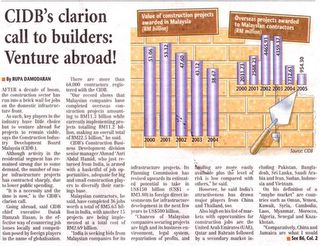
CIDB Call to Builders - Go Abroad Now!

It is a necessity and the time is now - GO ABROAD,” says CIDB CEO Datuk Hamzah Hasan. According to Hamzah, going abroad is the effective way of countering job losses locally and competition posed by foreign players in the name of globalization.

It was reported that CIDB’s Construction Business Development division senior manager Ahmad Asri Abdul Hamid who had just returned from India armed with a basketful of job opportunities, adequate for big and small construction players to diversify their earning base.

Ahmad Asri felt that apart from the need to build capacity, Malaysian contractors must change their mindset and strategise when going abroad. “Overseas is the way … but it is not easy.

The CIDB is at the same time concerned with the quality and ability of Malaysian companies to perform without tarnishing their image abroad. CIDB is currently looking at putting in place a process and mechanism to accredit contractors especially those involved in the overseas market.”

Ask the contractors why they are not going abroad?

The answer is simple. "Kalau tak boleh cari makan di sini, mana ada kemampuan untuk melabur seberang laut?

The first criteria of investment abroad is .....CAPITAL...MONEY... A LOT OF MONEY!!!!! To many of the local contractors, making ends meet is the current problem. Everyone will want to invest overseas, if they had the capacity and SEED CAPITAL. Those who are currently investing abroad, they are either Public Listed Companies (PLCs) or Extremely Rich Businessmen. PLCs can do it as they can seek financial fundings from banks or investment Bankers. Private Limited Companies... you need to come up with million dollars of collateral to get bank to approve any loans. And to tender a foreign project, just to pay for the Tender Bond, put tak Larat-lah!!!!

So, thank you for your kind wisdom, Mr CIDB!

For CIDB's information, almost all contractors knows (including any stupid ones) that going abroad is a right move which will expand the boundaries of business opportunities, but, can you go abroad with your underpants and singlets and tell the foreign client, "PLEASE TRUST ME, I CAN DO A GOOD JOB; I JUST HAVE NO MONEY; JUST GIVE ME A CHANCE PLUS 15% ADVANCE PAYMENT & I WILL PROVE TO YOU SAYA BOLEH DAN MALAYSIA SEMUA BOLEH?"

Why is it that the Koreans and Japanese are successful in investing abroad in the last 30 years? Firstly, it is their Government's policy and effort with strong encouragement and proactive actions from the authorities such as Works Ministry, Construction Development Board, Govt-owned Industrial Banks, etc. Their government had initiated and directed the Industrial Development Banks & Export-Import (EXIM) Banks to fund all contractors who could secure overseas Federal Government-funded projects. Those who could show a letter of award from government-sponsored project overseas, they would be given total fundings. All they do is assigned their payment certificate as collaterals to the EXIM Banks or Industrial Development Banks, and they will receive the cash flows to pay for the project expenses.

Can CIDB do the same for the local contractors, particularly, Bumiputra Contractors and would CIDB KINDLY arrange with the Govt to provide the fundings to Bumiputra Contractors? AND, PLEASE ....Is there any under-table fees?

Tuesday, March 01, 2005

Luxurious ‘EXCO Village’ for Selangor Top Guns

CERMELANG, GEMILANG DAN TEMBERANG


Luxurious ‘exco village’ comes under fire
BY LOONG MENG YEE, THE STAR, PAGE 2, NATION.

The Selangor State Government had spent an estimated MR40 million of public funds to built an “EXCO VILLAGE” in Section 7, Shah Alam comprising bungalows and a clubhouse exclusively for the use of Selangor executive councillors. State Opposition Leader Teng Chang Khim questioned the rationale for the estimated RM40mil project, which comprises 10 bungalows and a clubhouse.

“The state government pays each exco a housing allowance. This payment is more economical than constructing and maintaining the bungalows as the monthly maintenance fee is high,” he said in a press statement yesterday.

As for the clubhouse, he said the excos could become members of the hilltop Kelab Shah Alam by paying RM1,500 monthly.

It is believed that the idea for an “exco village” was mooted last year by the state leadership. The reason was to have a centralised housing area for the councillors, to facilitate easier meeting with each other and the Mentri Besar. They now stay in different locations, some even outside the capital here.

A state official said the bungalows would remain properties of the state. "Most likely, the exco members will lose their monthly housing allowance once they move into the official houses. The state will actually save taxpayers' money because these houses will appreciate in value. We do not have to increase their housing allowances anymore from now,” he said. He said the clubhouse would function as a recreational area and a meeting point; it could even host official events.

It was argued that the bungalows were not extravagant as even district officers and various department heads were given official residences. A survey at the site showed that it is a gated community with a clubhouse right in the centre. Some of the bungalows were fully furnished, complete with bedroom and dining room sets. The gardens had been landscaped as well and workers said the entire “exco village” project had been completed and they were putting the finishing touches.

Is this in compliance with the doctrine of "CERMELANG, GEMILANG, DAN TERBILANG"?

It looks like the government is more towards the doctrine of "TEMBERANG"

Selangor State had decided to increase water tariffs because they could not continue to subsidise the rakyat. But they had no problem to spent multi-millions in building bungalows to appease themselves, plus, paying for trips to watch belly dancers, etc.

Are the rakyat made to look stupid? Did we elect this people to govern us? Oh, my God!!!!!!!

Thursday, February 24, 2005

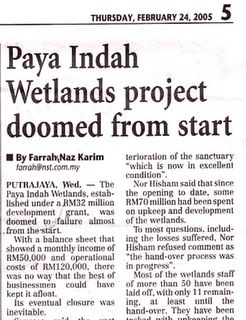
PLANNED TO FAIL - PAYA INDAH WETLANDS


PAYA INDAH WETLAND PROJECT

NST REPORTS - 24TH. FEBRUARY 2004.

The Paya Indah Wetlands established under a RM32 million development grant from the government was doomed to failure almost from the start. With a balance sheet that showed a monthly income of RM50,000 and operational costs of RM120,000, there was no way that the best of businessmen could have kept it afloat. Its eventual closure was inevitable.

So, why did the Government decided to go ahead with the project while the end results is predictable?

Failure to plan can caused failures. Planning to fail; the closure of Paya Indah Wetland in fact confirm that the plan was a success because it was originally planned to fail. Malaysia Boleh!!!!!!

Wednesday, February 16, 2005

Kelantan Bridge is Falling Down, Falling Down ...


Malaysia has 1st. Class Infrastructure?

Hundreds of schoolchildren uses this bridge daily. For umpteen years, residents of Pengkalan Pasir Village, 6km from Kota Baru, Kelantan had been appealing to the authorities for the repair of this bridge. On February 14, 2005, this bridge claimed its second victim. 5-year-old Noralili Mohd Yusof fell into the canal through a gap between the rotten planks. Last year alone, one villager was killed and two others broke their arms and legs.

Perhaps, now the authorities may act.

Didn't we say we have first world infrastructure and third world mentality?
Perhaps, we have both in the third world of darkness.

Friday, December 17, 2004

Water Commission Abandoned


On May 21st 2004, it was reported that "The government had put on hold the privatization of water supply in some states until a regulatory body to monitor water management is set up.

“I urge on-going privatization schemes to hold on to your horses because without benchmarks, the Government will in the end, be left with something unmanageable,” Dr. Lim Keng Yaik told reporters in KL on the 20th May.

Dead serious about improving the quality of water supply and services in the country, the Government is moving to set up by the end of this year a commission to be the sole regulator of the nation’s multi-billion ringgit water sector.

"We hope to do it by the end of this year," Dr Lim told the New Straits Times (March 3, 2004, NST). "I have to implement the National Water Council decision of last year for the Federal Government to take over the management of water from the States." To facilitate the establishment of the proposed National Water Services Commission, new legislation or even constitutional amendments may be necessary," he said. The proposed commission will oversee water supply and related services in all States except Sabah and Sarawak.

On July 27, as reported in StarBiz, Dr. Lim was reported to say that the Government was not asking for the “impossible” when it asked water operators and independent power producers to renegotiate their terms of agreement under the current structure of its privatisation scheme. Water, Energy and Communications Minister Datuk Seri Dr Lim Keng Yaik said the Government was merely asking the players in these two sectors to consider a new holistic structure in the utilities segment to make it more financially viable. “Many banks have come forward to offer their expertise to finance such projects and this shows that utilities projects are bankable,” he told a seminar in Kuala Lumpur yesterday. The Government was expected to invest RM50bil over the next five years to improve water and sewerage services, he said, adding that the amount was a third of the total to be spent under the 9th Malaysia Plan. He said given the huge investment, it was the ministry’s objective to establish a new model for the utilities sector, which would attract private investment and enable the industry to be self-financing and able to deliver to consumers first-rate service at a reasonable tariff.

On August 6, a group of 15 organization and associations, headed by Selangor Malay Chamber of Commerce and SYABAS Chairman, Tan Sri Rozali Ismail submitted a memorandum, addressed to Prime Minister calling on the Government to speed up the privatisation of water supply, if it had decided to do so. It was handed to Domestic Trade and Consumer Affairs Minister Datuk Shafie Apdal during a dialogue with the Selangor Malay Chamber of Commerce here today. Tan Sri Rozali Ismail said frequent water supply disruptions, poor water quality, low water pressure and other forms of water supply problems had consistently affected consumers. Among the points raised in the memorandum was that consumers were now having to purchase individual water filters as a result of poor water quality. Another was that consumers do not want to hear continuously about financial difficulties and the hassles of government bureaucracies before any suggested solution is put forward. An example is the setting up of the National Water Commission. The time that would take for it to be set up has been used as an excuse for not implementing remedial works and integrated actions to solve the problems. Another point raised was that inefficient management and planning of water resources had contributed to the increased level of water lost through leaking pipes, burst pipes and rampant illegal supply connections. These are the factors why water is not a revenue earner. Rozali said if immediate steps were not taken to solve the problems, it would be the consumers who would suffer and subsequently their businesses would be affected in many ways. "Consumers are often informed of the problems causing the lack of water supply but they are not being solved," he said.

On the same day, The Star reported that Dr. Lim had gathered a group of industry players to voice their other concerns pertaining to the water privatization scheme. The water industry players have urged the Government to review some of the contracts awarded by some states, saying they are inconsistent with the current plan to centralise water supply operations in the country. They said some of the contracts were only awarded recently, but not through the Economic Planning Unit (EPU), which oversees privatisation projects. “There could be some irregularities in the way certain contracts were awarded and they should be reviewed in the spirit of creating a level playing field for all water industry players,” an executive with one of the companies told StarBiz. Such concerns were voiced by industry players during a series of meetings organised over the past week by the Ministry of Energy, Water and Communications. “Most players in the state are unhappy about how some of the water contracts were unequal with one company enjoying higher rates than the others,” the executive said, adding that in one instance, payments received by a water company from the state government were based on its total capacity rather than its actual production, as was the case with other water firms. The difference in contract pricing, he said, had resulted in a higher water bill for the state water body, Perbadanan Urus Air Selangor Bhd (PUAS), which had to pay for treated water it did not use. In the long run, such contracts would also disadvantage consumers, the executive said.

On December 9, StarBiz reported that the Government has awarded the privatization of the management of water supply operations in Selangor, Kuala Lumpur and Putrajaya to Puncak Niaga group and Kumpulan Darul Ehsan Bhd.

On December 16, Dr Lim Keng Yaik was reported to say that “Klang Valley’s six million water consumers must be prepared for a 15% tariff hike in a year’s time.

Thus conclude the episode of National Water Services Commission Plan that most likely will not come into fruition, after all the HUHA...

Tan Sri Rozali had won and Dr. Lim can now think of retirement.

For the past many months since the loud proclaimation that the National Water Commission must be set up before the finalization of the water privatization scheme and the firm and unwavering stand of Dr. Lim, I thought, Malaysia now has ONE MINISTER who dares to stand tall and firm and will see his vision through reality. I stood by him, believing that he would not budge, that he is fully convinced that the Water Commission was what we need to resolve the long-term water problem and to set the standards for all other Ministers to Benchmark.

Alas, for whatever reason, either political pressure or self-weakness, the supposedly firm and courageous Minister falls, hard into the garbage bin.

PUAS $1 billion problem is no big deal for the government if they wanted to inject those money into PUAS. The Government can just get EPF to pay by way of issuing Government securities to EPF. So, the excuse that PUAS is in critical and dire straits is paranoid. The truth is, Politcal Maneuvering and Kelptorism.

It concludes that, we actually do not have a man strong enough to stand tall and willing to stretch his neck out, if necessary to be chopped, for the sake of his Vision, Mission and Objectives in the best interest of the Rakyat.

At such, the loser is not keng Yaik, but the Rakyat who will have to pay 15% extra in one year time and thereafter, .....only you can predict the outcome, the price of privatization.

God cannot help those who can't help themselves - the Rakyat!

God certainly help SYABAS ....and it's truely Syabas to Rozali.

Thursday, December 16, 2004

"5 Class F Contractor can becomes 1 Big A" says Samy Vellu


Samy calls 40,000 Class F Contractor to merge into 8,000

Datuk Seri Samy Vellu has suggested that the 40,000-odd Class F contractors merge into about 8,000 companies to bid for major government projects. He said it would be difficult for contracts to be given to individual Class F contractors. “We want to help the Bumiputra contractors but they also need to have vision and merge to get the projects,” Samy said.

I had the opportunity to talk to a few Class F contractors on this matter to see their reaction to the suggestion. The reaction are that:

As Class F contractors, they are short of funds and even if 5 were to merge into 1 as suggested, it would only equal to one bigger poorly financed contractor and they would still be unable to compete with the big boys who had the resources and connections. If 5 of them merge, and try to tender for a big contract, say, Class A or B, (for contracts that are $10 million and above), the performance bond alone would amount to $500,000 for a $10 million contract (5% of contract sum), of which they will not be able to afford. Class F contractors are companies below $10,000 paid up capital and 5 of them will add up to $50,000 paid up (and the paid-up had been fully utilized for setup of office and administration).

It can only be viable merger if the government will waive the performance bond and advance payment bond. That, the Government had to decide if they are absolutely sincere to help the Class F contractors.

Apart from the above issues, the main problems with current Class F contractors is the lack of projects for the 40,000-odd contractors. Big or mega projects are awarded to gaint contractors who would not sublet to Class F contractors due to lack of experience and resources. At such, they had to depend on small projects of which the income from their project will not suffice to cover their expenditure.

If the Government wants the Class F contractors to succeed, there is a need to look into the funding of their operation and providing free training and guidance to them over a period of time so that they will grow in their knowledge and competencies, at the same time, make a little extra money to feed their family, and hopefully, any extra cash leftover, will be used to increase their working capital.

Would the Government be willing to provide the needs of these contractors, or are they going to keep talking and suggesting solutions that are insidious?

Cakap Boleh, Bikin Tak Boleh. 1+1+1+1+1 = 1 Big F

Monday, December 06, 2004

Sarawak Bridge Projects Delayed


Two bridge projects in Sibu and Lundu have been delayed for far too long.


Works Ministry parliamentary secretary Datuk Yong Khoon Seng said the Government wanted to ascertain the reasons for the delay.

Datuk Seri Samy Vellu will visit and inspect both the RM96 million Durin bridge project in Sibu and the Batang Kayan bridge project in Lundu to find out the causes of the delay.

The Durin project started in 1999 and was supposed to be completed in 2003. The completion date had been extended to December next year (2 years delay???) due to the difficulties of piling works caused by strong river currents.

The Batang Kayan project was supposed to be completed in 2002. It was submitted that the tender price was too low and the contractor could not continue with the project.
Does any of my students knows of or are involved with these projects? Please tell me what happens!

Friday, December 03, 2004

The Third School without roads in Johor Bahru


SMK Mutiara Rini 2, located near Taman Mutiara Rini in Johor Bahru was supposed to have opened in 2002 was unable to take in students as there was no access road leading to the school. The school has yet to be connected with electricity and water supply. This the the third school in Johor who does not have access road. The other was SMK Tanjung Puteri Resort and SK Tanjung Puteri Resort which had been ready for 3 years. In both the later cases, the developer did not have the funds to build the roads.

Millions had been spent to built schools but are unfit to function.

Did we had a Ministry of Education and is there a Monitoring and Control system within? Or, did they had a Reactive System - i.e., attend to the problem as it arise (or as we receive complaints)?

Pak Lah says the Government will use KPI to measure performance. Does the Government knows:
WHAT to measure, HOW to measure, WHEN to measure, WHERE to measure and WHY measure???

The fundamentals of Performance Measurement System (PMS) is that the design of the performance framework that measures:

what we cannot do,
what we didn't do,
what we won't do, and
what we have yet to do.

The design analysis of the PMS is based on the WHYs of it. It should incorporate the Six Thinking Hats.

It must emcompass the evaluation criteria together with the design of the monitoring and tracking system of:

how we are going to get them (the performance),
when will we get them, and
what is the acceptable level of competency and efficiency.

In essence, it means we measure what was not performed and what that was performed which are below par-excellence, but that which need to be performed to an appropriate level within the system to be successful. It will also deal with the people within the system who consistently fails to achieve them over a period of time which is target-set and predefined by the management. The relative use of Benchmarking is not to set similar standards as your competitor, but to use the competitors performance level as a guide to achieve competitive advantage and sustainability of performance over a predefined period of time, i.e. before your competitors starts to overtake you in your game plan.

The system should also be Dynamic, NOT Static.

The system cannot, and should not be generic in form, that is, you cannot measure everyone with the same criteria - same standard evaluation criteria and same expectation.

Everyone in the company is an asset of different value and cost, acquired at a specific price, to perform a specific level of functions and an expected level of efficiency and competence. An asset (Human Capital) acquired at a low price cannot be expected to performed at the same level of another asset which is acquired at double the price. In another word, we pay for quality and we expect the minimum quality results. Similarly, if we pay peanuts, we should expect monkeys.

At such, the design of any PMS has to be dynamic to ensure fairness and reasonableness, and justify investments in Human Capital Management. At the same time, the system must also provide a channel for the asset (employees) who have the talent, capacity and capability, and the energy to produce performance beyond their current assignment and excel beyond it.

Thus, the dynamic system must have sensors and actuators to capture and recognize these potentials, groom, educate and train these potential people, and provide the necessary infrastructure, tools and techniques that are necessary for them so that they would work their way to achieve excellent results and productivity beyond their assigned level of responsibilities, to an optimum level of performance and productivity.

With this excellent results, it will translate to optimum Return of Investment for the organization and the shareholders, and at the same time, these assets (people) are rewarded accordingly. The appropriate Reward System will motivate the people to continually seek improvement and ensure the organization's sustainable performance and results.

One additional point to note is that, the system must be designed to ensure the appropriate integration of the various functional managers and communication needs that addressed the necessary cooperation and co-working with each other, that which is necessary for the achievement of the ONE Corporate Mission, Goals and Vision.

The Motto is: "Together, We Succeed, Divided, We Fail - and the Competitors WINS!"

Sunday, November 14, 2004

PMC puncanya, bukan JKR


"Dari tahun 1979 saya jadi menteri tidak pernah jadi macam ini''

- KATA DATUK SERI SAMY VELLU.

Utusan Online, 14th November 2004.

Datuk Seri Samy Vellu finally had finally the guts to come out in the open to bare all the viruses and worms that had plague the projects and had infected and infiltrated the whole Kitchen Cabinet.

Who was responsible for all the fiascos of project failures?

According to Samy Vellu, it is none other than the KSU, the Secretary general of the Finance Ministry who is the most powerful person in regards to decisions on project award.

This is what Samy says:

"Tetapi orang yang bertanggungjawab itu ialah Ketua Setiausaha kementeriannya. Ketua Setiausaha saja yang memberi arahan dan dia selalu tidak boleh menerima pandangan lain. Dalam satu-satu mesyuarat kalau ada para pegawai dari JKR untuk menjaga kepentingan teknikal, dia selalu malukan mereka. Dia kata, kalau tidak tahu tutup mulut."

"Beliau sedar bahawa semua masalah itu hanya muncul setelah perkhidmatan Perunding Pengurusan Projek (PMC) diperkenalkan oleh Kementerian Kewangan pada tahun 1990-an."

WHO DECIDES TO SET UP THE PMC?

This is what Samy says:

"Ia ditubuhkan oleh Kementerian Kewangan pada tahun 1990-an. Peranannya ialah untuk memansuhkan projek-projek JKR. Ada kepercayaan bahawa sekiranya projek-projek itu diberikan kepada PMC ia boleh disiapkan dengan lebih awal, lebih cantik dan macam-macam lagi. Malah projek yang mereka siapkan itu sebenarnya lebih mahal."

According to Samy, In the early 1990s, Mahathir's Govt had decided to engage the service of a Project Management Consultant (PMC) which are a composite cartel with faces and looks that resemble a contractor, may look like consultant and had shown interest as property developers and that entity is registered with the Ministry of Finance. The set up of PMC was meant to hijack all JKR's mega projects. It was claimed by the PMC that they are more efficient, more cost effective and can do a better job than JKR. The results speaks of itself: - Computer lab projects, Matrade Building, Hospital Sultan Ismail di Pandan, Johor, Kangar Hospital, Cameron Hospital, Langkawi School projects, et al; all these projects are now reverted back to JKR for reorganization and restructuring - to mitigate the damages done, and the multi million loses incurred; all tax-payers money.

As revealed by Samy, the PMC is a private entity who had only 2 officers manning the company - a managing director and a deputy managing director, and NO others. The Government, via the Ministry of Finance had entrusted and delegated the power to this PMC to appoint and select any contractors, design engineers, consultants, and nominated sub-contractors for all projects parked within their jurisdiction or those within the jurisdiction of the Ministry of Finance.

Snip from the interview:

Q: "Sebenarnya apabila Kementerian Kewangan sudah memberikan sesuatu projek itu kepada sesebuah kontraktor, tanggungjawab saya sebagai menteri hanyalah mengarahkan JKR supaya melantik kontraktor itu. Saya memberikan kuasa kepada Ketua Pengarah JKR untuk melantik kontraktor itu untuk harga yang telah ditentukan. Itu saja.

Ini bermakna Kementerian Kewangan mempunyai kuasa yang lebih besar walaupun Kementerian Kerja Raya mempunyai pakar yang boleh memberikan nasihat?"

SAMY REPLIED: YA, BETUL.

Q: Siapakah yang memeriksa PMC?

SAMY: TIADA SIAPA. (believe it? NObody manages or control or audit the PMC!!!)

Q: Kerajaan ada JKR tetapi kenapakah kerajaan memilih untuk memberi kepercayaan kepada badan swasta mengendalikan projek yang bernilai berjuta-juta ringgit? Apakah rasionalnya?

SAMY: Ada satu jawapan saja kepada soalan ini. Kata mereka, kerja-kerja itu boleh disiapkan dalam jangka masa yang cepat.

Q: Tanpa mempedulikan soal kos?

SAMY: Ya, tanpa mempedulikan kos. Apabila JKR membuka tawaran bagi setiap bilik darjah dengan harga RM55,000, ada juga pemaju yang bersedia menyiapkannya. Tetapi sebuah bilik darjah yang ditawarkan melalui PMC ada yang berharga RM95,000 dan ada juga yang mencecah sehingga RM120,000.

Kosnya sekarang sudah jadi berganda. Apabila kita tanya kenapa harganya jadi begitu tinggi mereka nanti akan beri berbagai-bagai penjelasan.

Sekolah-sekolah yang dibina dengan harga yang tinggi itu memang cantik-cantik. Tetapi siapa yang hilang wang? Kerajaan.

Q: Adakah pemaju-pemaju itu dapat menyiapkan projek-projek berkenaan dengan cepat seperti yang dijanjikan?

SAMY: Tidak juga. Ada sekali itu JKR telah diminta supaya mengeluarkan satu tawaran untuk pembinaan 500 buah sekolah dan kita sudah memilih lebih daripada 200 pemaju untuk melaksanakannya.

Tetapi apabila sampai masa kita hendak mengeluarkan surat niat, JKR telah diminta supaya menarik balik semua tawaran itu dan menyerahkannya kepada PMC. Semudah itu saja.

Q: Apa yang istimewanya tentang PMC ini?

SAMY: PMC LEBIH KUAT DARIPADA KITA.

Believe what you hear from Samy? PMC is stronger than Ministry of Works?

Is this the Government we had? That even the MINISTRY can be overruled by a PMC?

How is it that this can happen?
How is it that the Government had developed a dinosaur from a lizard within such a short span of a few years that is capable to destroy the Works Ministry and billions of dollars of project?
Who is behind the PMC?
Who's the GODFATHER behind it?
It cannot be the Jews?
Only UNMO can answer it; TRUST me!

Thursday, November 11, 2004

PWD instructed to manage Matrade Building to Completion

PWD: "YOU MANAGE MATRADE BUILDING"


PWD DIRECTED TO COMPLETE MATRADE BUILDING WITHIN 21 MONTHS.

On problems affecting the Malaysian External Trade and development Authority building in Jalan Duta, Samy Vellu said the contract was not awarded by the PWD. The contract had been given to Syarikat Perangsang International Sdn Bhd and it had been refusing to allow PWD officials into the project since the first day.

Now, the Public Accounts Committee (PAC) has directed PWD to complete and handover the building within 21 months from the date of receiving the funds from the Government. Why? It took 10 years for the Ministry of Finance to get the project to its current state of affairs and PWD is only given 21 months to finished up the mess? I believe, it must had been a promised made by the Director-General of PWD Tan Sri Zaini who had requested RM32 million from the Treasury for PWD to complete the project. Is 21 months & RM32 million sufficient to get the project completed? I hope it does; if not, Zaini will have to burn his ass to answer for it.

During the meeting attended by PAC, the Board of Architects and the PWD represented by Tan Sri Zaini, PWD promised to take legal action against the errant contractor and recover some of the losses. What???? PWD to take legal action? Samy Vellu said the contract is not awarded by PWD; how then can they take legal action against the errant contractor? Is Samy Vellu and Zaini talking about the same subject and same contract? According to Samy, Matrade was not awarded by PWD; then how can PWD take legal contractual action? Are our Ministers and D-G going NUTs? or, are they misleading us??? Please clarify!!!!!! My God, Please sent Tan Sri Zaini back to law school!!!!!

Thursday, November 04, 2004

Is Privatising PUAS Viable?

PUAS Dilemma

Urgent Need to solve water woes in Selangor
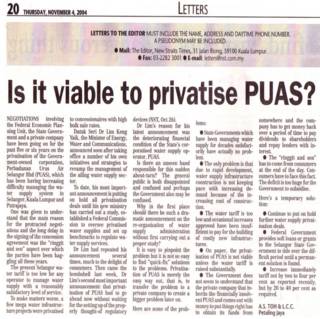


Refering to the NST article posted by AS Toh & LCC in the Letter to the Editor on November 4, 2004 pertaining to the problems besetting PUAS and the Selangor water woes, it had been suggested by the author that as a temporary solution, the Government should:

1) Continue to put on hold water supply privatization deals;
2) Federal Government to provide soft loans or grants to the Selangor State Government to tide over the difficult period until a permanent solution is found; &
3) Increase immediately tariff not by 2 to 4 sen but by 20% to 40% as required.

The proposal was meant to be temporary until a permanent solution is found; according to the author.

The Poser is:

What is temporary? When will the permanent solution be found?

The problems of PUAS was known and discussed within the government for more than 10 years and many solutions were forwarded and implemented including the increase of water tariff. Did the solution solve the problem - NAYs! Why??? Because the problem of financial losses and debts was not the root of the problem. Then, what was the root of the problem?

Firstly, the problem arises due to water shortages. This was a direct result of the failure to plan for the need of the State in the blueprint. 20 years ago, there had already been a proposal to built the pipeline to deliver water from Pahang to Selangor. The proposed project to be funded by the Japanese was put on hold primarily for reason of financial constraint and priority. But we spent billions to built Twin-Tower, KLIA, Putrajaya, Cyberjaya, and many highways around the country which would had been construed to be more important than the water project. PUAS CEO Datuk Mohd Sinon Mudzakir had repeated mourn publicly that "The Inter-State Water Transfer Scheme needs to be realised urgently or Malaysians will face a water crisis in 4 years. A system allowing water to be delivered to States lacking in the resource needs to be in place. There will be a crisis by 2008 if it is not implemented quickly,” Did anyone in the Cabinet respond to his SOS call? The respond by Dr Lim Keng Yaik was blinker-focussed on the privatization of the whole water management services but will never address the supply-side which ultimately will surface soon, maybe in 3-4 years time, as projected by PUAS CEO. Looking at the perspective of solution-making, the Government will not solve the water problem until the long-term needs of water for the State was addressed with a long term solution; but the State Government had implemented many other solutions. They privatized the treatment of water to various companies and the contract price was a fortune to the consortium as acknowledged by PUAS. Apart from the pricing, the methodology of billing and metering the quantities of treated water was far too advantages to the consortium. What it meant is that the consortium will be paid for all the water that leaves the treatment plant but PUAS will receive revenue for what was actually delivered and consumed by household and industry. The pilferage and wastages in-between the 2-point of measurement is borned solely by PUAS. And, if you (Consortium) bill me (PUAS) 1 gallon of water at treatment plant out-point valve and meter, how do I check and confirm that it was actually 1 gallon - i.e. what is the Control System and how do we audit? Are you sure the current system is adequate and sufficient to ensure nobody can abuse the current recording system of delivery?

Apart from that, who is responsible for the pipeline and the leakages? We privatized the meat but left the bones for PUAS to chew and expect them to survive? PUAS didn't and so the next course of action is: THE PROPOSAL TO INCREASE THE WATER TARIFF TO COMPENSATE OR TO OFF-SET THE LOSSES. So, who was made to pay? The Rakyat!

The water tariff in Selangor is $0.57 for domestic and $1.80 for commercial. For domestic water tariff, Johor is $0.38, Perak is $0.30, Pahang is $0.37, Kedah is $0.40 and Penang is $0.22. For commercial tariff, Selangor is $1.80, Johor is $2.22, Perak is $1.20, Pahang is $0.92, Kedah is $1.20 and Penang is $0.52. And Penang JBA is making a sound profit. From figures above, Selangor is non-competitive and the question arises should be - WHY??? Is it due to poor management, high cost of poor quality, wastages, inefficiencies, ineffective policies, poor or no proper control system, poor maintenance management system, high cost of overhead, et al. Had the Government start pondering the above questions SINCERELY & TRUTHFULLY? There are many things known but not spoken publicly and those comments come from the sources within the system itself. Kleptorism was within but the issue was : It was actually desired!

ON PRIVATIZATION

Withholding privatization is not the answer. Privatization is a certainty but the National Water Commission must be setup and are fully equipped and operational to Man & Manage the system, i.e to PLAN, EXECUTE & MONITOR AND CONTROL the complete water supply and delivery services and includes the maintenance and repair management framework and that the system had considered the needs for the next few decades; otherwise, the solution to the problem begets new and more deadly problems.

ON WATER TARIFF INCREASE

Increase of water tariff by 20 to 40% will burden the rakyat and the consequences had to be considered thoroughly and wisely. The Hypothesis issue is: The consumer is made to pay for systemic failure, cost of poor quality, inefficiency and kleptorism.

ON SOFT LOAN FROM FEDERAL GOVERNMENT

Providing soft loans to PUAS is not the answer. It's is TINKERING with the problem. Give them $2 billion today and in 6 months time they will be broke again, and shall need another $2 billion injection.

Khazanah owns so many corporations, are cash rich, and were supposedly great and efficient managers. Why doesn't the Government consider a test on the management of Khazanah by privatizing the system (without tariff increase at least for the next 5-years) as a whole to Khazanah and find out how good the management are? Are they afraid to take the challenge and prefer to invest in safe and secured investments?

Petronas, another super-tycoon and had investments in so many sectors such as energy, should be considered to accept the responsibility of water management, which is also ENERGY BUSINESS. Their success is gains from raping Mother Nature, and water is Mother Nature too. Why are they allowed to suck black gold and not white gold? Even if they had to subsidies water from the gains from black gold, both assets of Mother Nature, isn't it fair?

The paradox is: Profitable business, I manage, complex, less profitable and high probability of loss business, you manage - that's what GLCs are about. And they claim they are great managers - MY FOOT!

Another PARADOXICAL THESIS: Since Penang water management had proven to be successful and efficient, why not bring the team of managers including their CEO to PUAS and let them turnaround the organization? I'm certain, they will succeed!

Policy-makers, planners and implementers would be wise to take heed of the recommendations contained in the National Water Resources Study (NWRS) plan which was submitted and accepted by the Government. The Government cannot plead innocence any more, if somehow, somewhere, the rakyat suffer from water shortages. A lot is at stake.

POS SLIM Highway is Dangerous

"POS SLIM HIGHWAY DANGEROUS," says Samy Vellu


PWD PERAK REFUSED TO ISSUE CF ON SAFETY OF HIGHWAY, BUT......


The Simpang Pulai-Cameron Highlands stretch of the East-West Highway will be closed daily after sunset until further notice. The closure was ordered by the Cabinet today after engineers recently found that the stretch was too dangerous for motorists. It was earlier reported that water had seeped into the slopes along the highway and some movement had been detected, especially between Pos Slim and Kampung Raja. Samy Vellu had also said that there was some movement of between 0.3m and 0.45m.

On the 4th Feb 2004, The Star reported that the 282mil highway from Pos Slim to Kampung Raja in Cameron Highlands is completed but PWD has refused to issue a safety certification for the road. The PWD feels that it’s dangerous for use as km22.5 and 25.5 is too steep and prone to landslides. The slope gradient was not constructed in accordance to the PWD standard. The PWD is of the opinion that the construction has not met its requirement.

On 17th October 2004, The Star again reported a statement from the State Director of Perak PWD, Datuk Dorairaju. “We know the road was not really completed when we opened it in February. It was opened after pressure from the people in Cameron Highlands who were affected by a landslide near Ringlet,” commented Datuk Dorairajoo.

According to Samy Vellu, the Works Ministry was considering closing the highway in order to facilitate the construction of a proposed new tunnel which will be 1.5km long. The tunnel is expected to cost between $30-50million.

QUESTION THAT SHOULD BE ASKED:

Why was the tunnel not designed and built by the earlier Turnkey Contractor?

Is it a question of design omission, or a failure of the PMC & design consultants to take into consideration the fundamental requirements during the earlier contract?

Is there a Failure of Duty of Care, Professional Negligence and can TORT actions be taken? Or, did the Turnkey contractor failed to comply to the requirements stipulated in the Need Statement of the contract?

The project was a Design-Built-Lump Sum contract from point A to point B (as per the need statement from PWD).

How could it be that we now say we will need a tunnel when the designers had not deemed necessary at the point of the contract been made?

Was the designer over-ruled?

Did the contractor short-change the Government?

PWD and Works Ministry had to answer it point blank and not hide behind the maxim of Act-of-God again. Infact, ACA should be as pro-active as they had been with the Karak Highway investigation, by investigating this problem.

Coincidently, both the problematic highway (Simpang Pulai- Kampung Raja and Karak Highway) were constructed TURNKEYED by MTD Capital.

The problem that have surfaced now and more to come in the future was predictable and known-knowns. It is just that our Ministers choose to side-step the issues that were raised before it happen (before the contract formation), and hope it doesn't happen (after the contract completion). JKR Perak knew of the problem. They couldn't talk out loud as they may lose their job and income.

Well, Murphy's Law again: If you think it can happen, It will happen! & The solution to a problem breeds new and more virulent problems. Problem begets problem. Inefficiency breeds inefficiency.

Datuk Seri Samy should admit his delinquency and work towards an effective solutions, even if it has to be painful to vindicate himself. He should not be shielding incompetencies and the incompetent contractors. He must wake up, and for once, solve those problems he had allowed to happen when he concurred on those decisions with his fello cabinet ministers, of which he shall have to accept responsibility and the consequences for the last 20 years of folly and political patronage.

Tuesday, November 02, 2004

16 School & 5 Colleges Defective


16 Schools & 5 Colleges Defective - All built by same contractor

16 Schools and 5 Community Colleges constructed by Project Management Consultant (PMC) a construction company appointed by the Finance Ministry have serious structural defects and PM had directed PWD to take over the buildings and prepare a complete report on the matter.

“Now we have to find out who is the contractor, who is PMC and who is the consulting engineer,” says Datuk Seri Samy Vellu.

How could it happen? Isn't the contractor a registered PKK Class 'A' entity accredited by the relevant authority presumably based on their qualification and competency and that the selection process had taken into consideration the fundamental requirements of a competent contractor? Or, is the selection based on political intention with the necessary mens rea?

Murphy's Law has always been proven right. What you think can happen, would happen.
To most of the industry players and project management professionals, it was known-knowns and it's a matter of time for these failures to unfold; the only regret is that it is the tax-payers money that was dumped into the incinerator.

Which Ministry is responsible? Who would be made accountable?

For me, the nostalgia is that the company chose a name PMC which should reflect their true project management competency and ability but sad to note, it brought injustice to the project management fratenity.

The most shameful part is that the MOF, MOE and probably, PWD are made to look as if they don't even understand what is project management and what is construction management.

Worst off is, Pusat Khidmat Kontraktor (PKK) who are delegated by legislature to accredit and rank those contractors (by meritocracy) don't even have the basic knowledge and competencies of engineering and construction technology to evaluate the skills and competencies required of a contractor. This goes the same for CIDB. I wonder when the PM would start taking a look at CIDB and see the worms roaming around in India and Sri Lanka, performing the role of a contractor instead of the role of promoting and developing the construction industry, and regulating and monitoring the industry's performance and key indices. When will we do the right thing and when will it happen? Where is the institution that will do the right job? How is the hundreds of millions collected by CIDB been utilized? Will there be transparency and accountability? Who cares and who is going to care? Will Pak-Lah wake up?

Monday, November 01, 2004

$500,000 TOILET that Nobody shit

Toilet built at $500,000 & now a ghost home


A Thai-style public toilet sited at the Manjalera Lake Garden in Kepong, KL was designed to be so lavish that it would cost RM500,000.

The toilet had been furbished with imported ceramics tiles, marble-top basins and amenities normally linked with 5-star hotels. It include imported decorative lights from Spain.

A staff member at the contractor’s office said the facility was almost complete but had yet to be handed over to the Park Management as the fixing of the decorative lights from Spain had not yet done because of short supply.

The toilet is now more than 2 years under construction and has become a living quarter for some illegal foreign workers.

The RM98 million hospital project in Cameron Highland was a 2-year project and was now 5 months delayed with expectations that it will need another 6 months to complete. The Works Ministry had terminated the contractor's contract.

"But the toilet project is also 2-years (worth only $500,000) and they are not being terminated yet," Mercu Jaya cried foul. The RM 176 million Matrade project is 10-years since, and they are not terminated? The Simpang Pulai- Ayer Raja highway was completed in more than 7 years and they were not terminated? Does the Ministry had a standard criteria for termination or they do it as they deemed fit. It looks like you had to be a political crony to stay in business.

Thursday, October 21, 2004

Fungi Problem in JB Hospital

MINISTERS TRAPPED BY FUNGUS INFECTION


1) SAMY VELLU BLAMES HOSPITAL MANAGEMENT
2) CHUA SOI LEK BLAMES PWD

According to Samy Vellu, the fungus problem at the new $557.8 million Sultan Ismail Hospital in JB was caused by the failure of the hospital management to undertake routine maintenance but Health Minister thinks that the problem was due to structural defects.

The hospital was supposed to be completed on July 29, 2002, but 3-extensions were given due to various problems and was only completed on Nov 14, 2003 and handed over to the PWD on Feb 15, 2004. The Health Ministry took over from the PWD on March 2004 and appointed Pantai Medivest Sdn Bhd to oversee daily maintenance and monitoring of the building supervisory systems, reporting defects and damage to the main contractor. “There was no daily routine checks on the hospital due to lack of staff. The presence of the fungus on the 2nd and 3rd Level of the hospital was due to damage to the air-conditioner valve, which was not reported as there was no building supervisory system,” said Samy Vellu.

However, Dr. Chua said the fungus problem was due to structural defects and not due to delay in routine maintenance. In dismissing Samy Vellu’s report as “Defective” Dr Chua said the fungus was caused by the dampness in the hospital following leakage in its major roof and low human traffic.

“The roof was like a big retention pond,” said Dr Chua. “We (Health Ministry) received the hospital in good faith on March 15 this year but it was full of defects. Besides major leaking problems, there were also problems in the piping system which had affected gas flow and also problem in the sewerage. The problems were made known to the contractor, who had promised to rectify them but did not do so,” Dr Chua said yesterday.

So, who was right and who is wrong????

Actually, both Ministers are right!

Hospital management must make routine inspections and if the air-conditioning valve was damaged and unreported (as claimed by Samy), definitely, it will cause dampness and ultimately leads to fungi growth - SO, SAMY WAS RIGHT! Hurray Uncle Sam.... but.....

Well, at the same time, the roof was a retention pond, there were major leaking problems, piping problems, and sewerage system failures of which the promised restification was not done timely, as claimed by Chua Soi Lek - THEREFORE Dr Chua IS ALSO RIGHT! Yahooooo......but.......

THEN, who is WRONG? Who is the CULPRIT? Is it the CONTRACTOR (MH Project Sdn Bhd) or the HOSPITAL MANAGEMENT SERVICE PROVIDER (Pantai Medivest Sdn Bhd)?

Ironically, both Ministries would not look into the contractual aspects related to the problem. The question arises are:

1) If the health Ministry was not happy with the conditions of the facility of which it was alleged that the works are not conforming to the specifications and standards, then why did they willingly, take over the building? GOOoood FAITHhhhh? Now, it's bad BLOOooooD!

2) If the roof is like a retention pond, (as claimed by Dr Chua), and is leaking badly, it is amusing that PWD had issued a Certificate of Completion (CPC) to the contractor ....... that's professional negligence on the part of PWD engineers.

3) Since taking over the facility by the Health Ministry, how is it contractually managed with regard to Defects Management and the contractual communication related to the Defects Liability Period of the contractor? And how is it that the line of communication seemed to be that the Health Ministry was talking and liaising directly with the main contractor which is not what the contract stipulates - i.e, the contract requires the Superintendent Officer (S.O.) to issue instruction to the main contractor for defects rectification during the defects liability period and failure to respond timely by the contractor, the contract does provide the S.O. to engage others to carry out the work and the cost incurred shall be debited to the contractor. At such, the question that the contractor did not respond to the Health Ministry's Instruction did not arise as the contractor need not take instruction from the Ministry except from the S.O.

In conclusion, the allegation against the contractor is mala fide. The contractor may have done a bad job, but since the employer (i.e. JKR) had accepted the works and issued the CPC, the contractor's responsibility is presumed to have been fulfilled if they did not receive any instructions from the S.O. to make good any defects; and the contractor cannot be held responsible for the damages arising thereof. Morally and socially, the contractor maybe the cause or the contributor to the problem but contractually, he is absolved of the responsibility if the failure on the part of the S.O. to give the necessary instruction did not take place.

Since the Health Ministry had decided to be friendly, and .... have GOOoooD FAITHhhhhh, and had INFACT, contractually accepted to take over the facility, then, they had taken over the contractual responsibility to manage the building and it's associated services; and they must be held fully responsible - for their actions and their decisions. In that sense, when the service management contractor was appointed to manage the building, how could they claimed that it was not their fault that they did nothing except to wait for the main contractor to rectify the defects, which in reality, they should be taking proactive actions to ensure that the building and its services are functioning in accordance with the operation definition. Where is the "Duty of Care" & "Reasonableness" ?????

A Contract is a Contract; Nothing More, Nothing Less!

Every party to the contract must know their role and responsibilities as laid down in the terms and conditions of contract. Every party to a contract must understand their "Rights" and their "Obligations". Each party must also know of the associated risks they will face and the consequences of their decisions and actions that lead to the risk that had happen. Even among the Ministries, there is an unwritten contract of "Duty of Care" and a "Duty to the Rakyat" for spending $558 million on a facility that is malfunctioning and would not serve it's objectives.

The same goes to the Highway problems (MRR2), East-coast Karak Highway shambles, The Langkawi "White Elephants" Schools, and the Matrade Building Debacle. Infact, there are many more systemic failures in Government projects ... computer lab fiascos, PUAS fiascos, Simpang Pulai - Kampung Raja Sloppy slope design (awaiting failures), Gemas Army Barrack project & payment fiascos, Gua Musang- Lojing Highway Slope failing (awaiting failure), Broga landfill project fiascos, et al.

More of these bad news will surface soon and probably, Pak-Lah who had directed the Sports Ministry to form a Cabinet Committee for sports revitalization may also have to form another Cabinet Committee and Advisory Panel to manage the Government Project Management System. The Sports Committee headed by Azalina engaged Hallam Pereira to tell her what our sports officials had already told her predecessors; and so, the Government Project Management committee may also need a foreign consultant to tell them what we local professionals had already known and widely spoken and discussed within the project management community. Is that the Government's way of SOLUTION MANAGEMENT - i.e engage Foreign Consultant, pay through your nose and get a "BLUEPRINT" of our known problems and known solutions and then ARCHIVED the file. IMPLEMENTATION? NAY, NAY, NAY .....oh NO NO NOooooo!!!!!
CAKAP TAK SERUPA BIKIN - MALAYSIA BOLEH LAGI.

Tuesday, September 14, 2004

Ailing Klang Hospital - No Maintenance Framework

POOR MAINTENANCE MANAGEMENT OR NO Maintenance Management?


HOSPITAL WOES

DO WE HAVE PROPER MAINTENANCE MANAGEMENT OF HOSPITALS
OR WE ONLY CARRY OUT DEFECTS & RECTIFICATION MANAGEMENT AS THEY OCCUR?

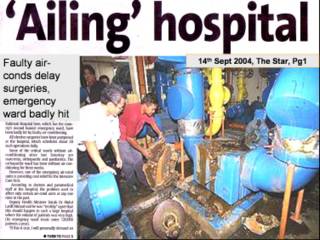
The Star Front-page: Ailing Hospital:
SEPTEMBER 14, 2004

Services at the Tengku Ampuan Rahimah Hospital in Klang, which has the country's second busiest emergency ward, have been badly hit by faulty air-conditioning. All elective surgeries have been postponed at the hospital, which schedules about 20 such operations daily.

A doctor claimed that the air-conditioning system had broken down “a few hundred” times over the past two years in different units, with some breakdowns lasting from a few hours to eight days.

“Sometimes, they happen a few times a day. We have the records to prove this."

Hospital deputy director Dr Ismail Mohd Yusoff said he had done his best by bringing the problem up with the authorities. “The Cabinet and the highest level in the Health Ministry know about our plight. “Many say they empathise with us, but we are still waiting for the funding,” he said.

Pak Lah had just delivered his budget and we wonder whether the state of affairs in hospitals had been addressed in the prevailing budget.

Often, we read of budget that projects the prospective future but rarely address the problems that we had been facing, such as the Tengku Ampuan Rahimah Hospital in Klang. This is not the only hospital that is facing the problem of poor maintenance management system. Many government buildings and facilities are also in dire straits.

The question arise:

"Do we have an effective Hospital & Public Facility Maintenance Management System in place or do the government and local authorities manage maintenance as and when the problem arises? Its ironical to hear from THE DEPUTY DIRECTOR of the hospital that the Cabinet and the Health Ministry had been informed of the critical problems that had existed for so many years and that they had known of the problem and are empathetic towards the hospital staffs but are waiting for the fundings. If thats the case, then what is the yearly budget trying to address? The government spent tens of billions each year on building highways and roads and are proposing to spent a few more billions on Penang Second Bridge but what about the maintenance of all existing government facilities and buildings?

Isn't this SYSTEMIC FAILURE????
CAKAP TAK SERUPA BIKIN.

Monday, August 30, 2004

Developers have to deposit 40% of Project Cost

Khir Toyo: Developers have to deposit 40% of Project Cost


ARE YOU REALLY SERIOUS ABOUT IT - THAT IS TO INSIST THAT DEVELOPERS HAVE TO DEPOSIT 40% PROJECT COST IN A BANK AS PERFORMANCE BOND, OR ARE YOU CAKAP SIA SIA SAHAJA?

To ensure that housing projects are not abandoned, Selangor wants developers to put 40% of the overall development cost in a bank before land conversion is carried out.

Mentri Besar Datuk Seri Dr Mohamad Khir Toyo said the 40% was based on past situations where projects were abandoned with 30% to 40% yet to be completed.

He said the requirement was to protect the interest of potential house and commercial property buyers.

“Forty percent is a justifiable amount. The requirement is based on the 36 abandoned projects in the state which had been left idle with 30 to 40% yet to be completed."

“With the 40% in the financial institution, it would act as a surety to ensure that the project is completed."

“With this mechanism we feel it would give birth to developers with excellence,” he said.

He said the state would also put a stop to the unscrupulous method of developers who used the buyer’s initial and progress payments to push through a housing project to rake in the profits upon completion.

Dear MB, its a fantastic idea!!!! But do you & your EXCO members have the balls to implement that requirement or you are just poking pointers at some developers so that they come running to you and your EXCOs to negotiate at the mamak stall?

I'm sure REDHA will be horning loud in the next few days and Ong Kah Ting will speak in tongue soon. lets wait for more!!!!!

Friday, August 27, 2004

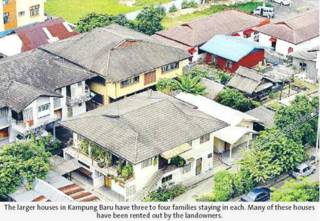
A New Kampung Baru Proposal


KAMPUNG BARU OR KOTA RAYA BARU?


A group of influential Kampung Baru residents has proposed that a statutory body be set up to develop the settlement, one of the largest undeveloped real estate left in the city. They have drawn up plans to be submitted to the Government that the agency, modelled after the Putrajaya Corporation, handle matters such as land acquisition and compensation to residents was the only way to satisfy all parties.

The agency will act as the middleman. Previously any attempts to develop included a third party who had an interest.

“We are going to suggest that the Government sets up an agency, which paid compensation and had the right to develop the area. Redevelopment will be done in blocks or precincts,” said a source.

The initiative is headed by Titiwangsa MP Datuk Astaman Abdul Aziz.

However, the status of Kampung Baru, as a Malay Agriculture Settlement, must be repealed if any redevelopment was to take place on the 90ha village.

The development until now could not be done because the people could not be paid the amount they were asking for, which was anything between RM250 and RM500 per sq ft.

“Since it is Malay Agriculture Settlement land, it cannot be owned, transferred or occupied by non-Malays. There are existing bylaws where buildings cannot be more than five floors and compensation will be very low compared to commercial land.” Under the proposal, the residents will not be paid 100% in cash.

“We want to avoid a situation where we give them money and they end up spending it all without saving. We will suggest giving them financial instruments such as bonds, where they will get houses once a precinct is completed,” the source said.

The interesting point to NOTE:

The clergy and those wisemen who are proposing the project development are saying that the Kampung Baru people don't have ability to take care of themselves and at such, they need a body managed by the clergy, to control their monies, how they spent the money, when to spent, what to spent and at what proportion it will be given to them. If you are one of the land owner in Kg Baru, how do you feel? Isn't this statement a contempt; a total disrespect to the people of Kampung Baru?

The people in Kampung Baru are not stupid as make out to be. If you take a good look at the quality of their houses and the way of life, their entrepreneurship ability, you will know that they are doing reasonably well because they are wise and frugal. It is those businessmen who are eyeing Kg. Baru development that will benefit themselves first, and they are looking into ways of a reduced working capital, a longer period of payment of compensation and the creative methods of financing their project with lesser capital by paying the compensation in bonds, stocks, debentures, warrants, deferred payment, etc. At such, they have to camouflage their intend by pronouncing their concern of how the money will be spent on behalf of the interest of the people in Kg Baru.

There's a saying of these clergies:

DI DEPAN KEDAI,KEPALA RUSA DI GANTUNG,
TETAPI SE BENARNYA, YANG DI JUAL ADALAH DAGING ANGING."

MALAYSIA BOLEH .... tipu!

Sunday, August 08, 2004

WATER PRIVATIZATION - THE WAR BEGINS

Water privatization

PUNCAK NIAGA BEGINS WAR WITH LIM KENG YAIK


75,000 ROZALI'S STAKEHOLDERS WITH INTER-RELATED INTERESTS & PERSONAL INTERESTS CONSPIRED UNDER THE BANNER OF SELANGOR MALAY CHAMBER OF COMMERCE (OF WHICH ROZALI IS THE PRESIDENT), SENT A MEMO TO PM TO SPEED UP WATER PRIVATIZATION AWARD TO SYABAS-PUNCAK NIAGA IN THE PRETEXT OF THE WATER WOES FACED BY SELANGOR RESIDENTS.

The memorandum, addressed to Prime Minister called on the Government to speed up the privatisation of water supply, if it had decided to do so.

It was handed to Domestic Trade and Consumer Affairs Minister Datuk Shafie Apdal during a dialogue with the Selangor Malay Chamber of Commerce here today.

The signatures were collected by a group of 15 organisations and associations who largey comprises his cronies, his consultants for the target project and his probable sub-contractors and suppliers, and probably his staffs and includes those others related.

Chamber president Tan Sri Rozali Ismail said frequent water supply disruptions, poor water quality, low water pressure and other forms of water supply problems had consistently affected consumers. Among the points raised in the memorandum was that consumers were now having to purchase individual water filters as a result of poor water quality. Another was that consumers do not want to hear continuously about financial difficulties and the hassles of government bureaucracies before any suggested solution is put forward. An example is the setting up of the National Water Commission. The time that would take for it to be set up has been used as an excuse for not implementing remedial works and integrated actions to solve the problems. Another point raised was that inefficient management and planning of water resources had contributed to the increased level of water lost through leaking pipes, burst pipes and rampant illegal supply connections. These are the factors why water is not a revenue earner. Rozali said if immediate steps were not taken to solve the problems, it would be the consumers who would suffer and subsequently their businesses would be affected in many ways. "Consumers are often informed of the problems causing the lack of water supply but they are not being solved," he said.

LIM KENG YAIK WAS EQUALLY QUICK & WITTY. HE TOO CALLED FOR A MEETING WITH INDUSTRY PLAYERS AT HIS MINISTRY.

In that meeting, it was reported that water industry players have urged the Government to review some of the contracts awarded by some states, saying they are inconsistent with the current plan to centralise water supply operations in the country. They said some of the contracts were only awarded recently, but not through the Economic Planning Unit (EPU), which oversees privatisation projects.

“There could be some irregularities in the way certain contracts were awarded and they should be reviewed in the spirit of creating a level playing field for all water industry players,” an executive with one of the companies told StarBiz.

Such concerns were voiced by industry players during a series of meetings organised over the past week by the Ministry of Energy, Water and Communications.

“Most players in the state are unhappy about how some of the water contracts were unequal with one company enjoying higher rates than the others,” the executive said, adding that in one instance, payments received by a water company from the state government were based on its total capacity rather than its actual production, as was the case with other water firms. The difference in contract pricing, he said, had resulted in a higher water bill for the state water body, Perbadanan Urus Air Selangor Bhd (PUAS), which had to pay for treated water it did not use. In the long run, such contracts would also disadvantage consumers, the executive said.

EPILOGUE:

It can be clearly seen that Tan Sri Rozali is getting impatient and sense that he and his Puncak Niaga will not have an easy time with Lim Keng Yaik as regard to the price he wants and the profit that was presumably assured by the Mahathir's regime. So, before the National Water Commission gets to the parliment for approval, he abused his position in the Selangor Malay Chamber of Commerce by selectively organizing his group of cronies and stake-related-holders to present a Memo to the Prime Minister in an effort to apply communal political pressure under the disguise of the interest of Malay Chamber of Commerce and the selective Malays in general, to discredit Lim Keng Yaik and forced him to back-off or they would trash him into pieces.

God forbid if Rozali ever managed to get his way, it will spell the death of democracy and meritocracy, which is the core integrity of Badawi's government. The game is getting insidious and they are treading the line of communalisim and exclusivism. My wonder is: "Was it the intent of the privatization deal made by Mahathir, to be on communal basis and is Rozali representing the Malay chamber of commerce and the malays as a whole?

When it comes to money and the get-rich quick national-economic-scheme, you will see the declared public angel unweils his devilish fangs.

I hope the nation gets behind Keng Yaik to thwart-off the schemers. We can never find another brave man in the likes of Keng Yaik, who had the absolute courage to stand by the right principles and who isn't afraid to lose his neck which is out-stretched to the limit in order to protect and uphold the Rakyats' interests and in exposing the national robber barons.

KENG YAIK BOLEH & WE HOPE PAK-LAH WILL SUPPORT YOU!