Monday, September 26, 2005

Kuching Airport Extension - Progress Photos

September 25, 2005


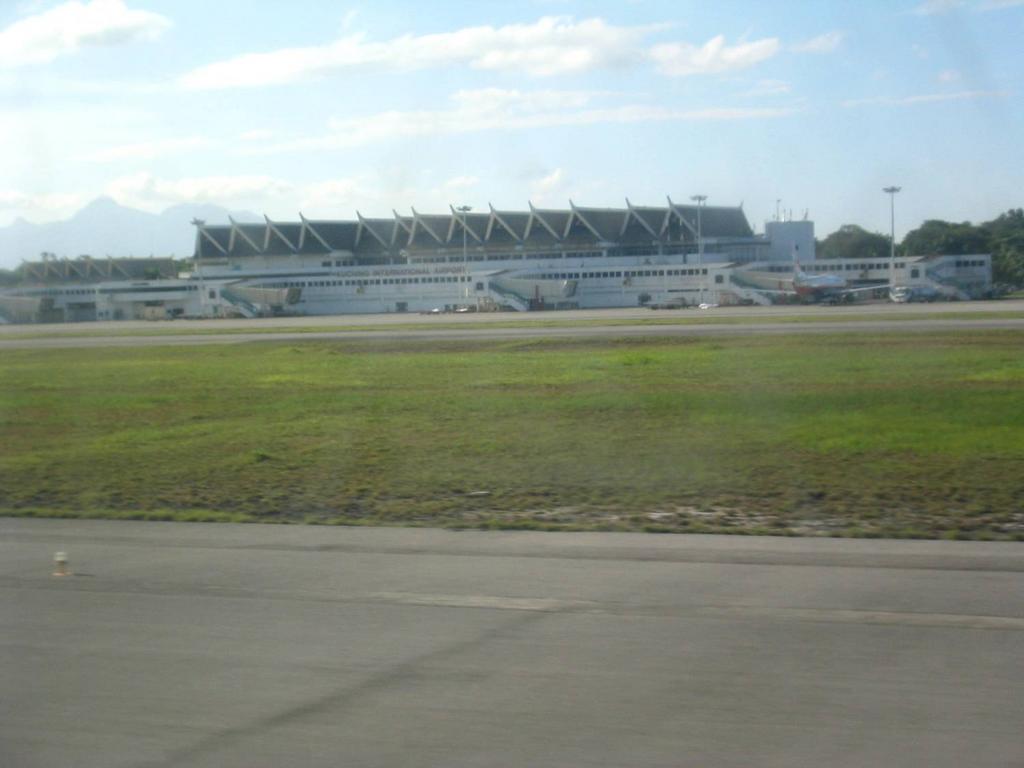
Kuching International Airport is undergoing extension works.


Shots taken unpon entering the terminal building. Note that the escalators had been sealed off and passengers checking-in at the first floor immigration check-point must walk up through the stairways.


Temporary Hoarding along the passageway where passengers will have to walk to the taxi stand. Note that they are full of holes and lack of maintenance culture.


View from the passageway where part of the hoarding was removed.


Shots taken from the taxi disembarkment stand


On arrival at the Kuching airport from the town, we took this shots

Sunday, September 25, 2005

Kuching Airport: Quality or Myth?


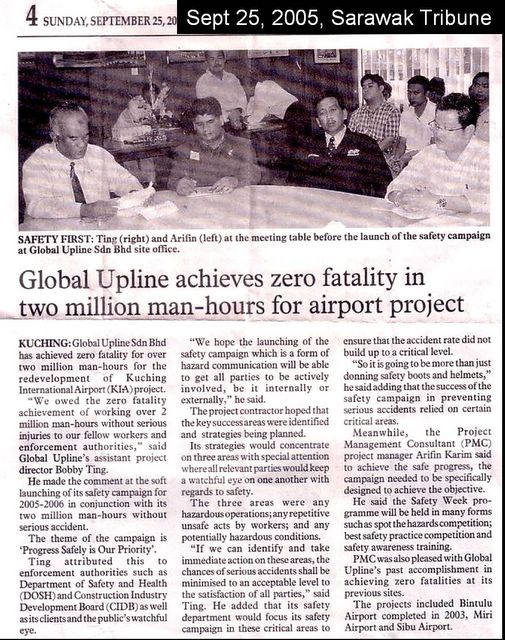
Global Upline Sdn Bhd, the turnkey contractor for the redevelopment of Kuching Airport (Extension) which is currently in progress has reported achievement of ZERO fatality for over two million man-hours. This was reported by their assistant project director Bobby Ting, the son of Tan Sri Ting Pek King, the superman of the construction industry.

The project contractor hoped that the key success areas were identified and strategies being planned. Its strategies would concentrate on three areas with special attention where all relevant parties would keep a watchful eye on one another with regards to safety. The three areas were any hazardous operations; any repetitive unsafe acts by workers; and any potentially hazardous conditions.

Bobby Ting said that its safety department would focus its safety campaign in these critical areas to ensure that the accident rate did not build up to a critical level.

The reported zero fatality of two million man-hours are applauding and an excellent record. The only question that arises is :

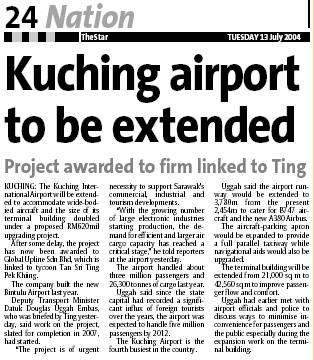
The project is only about one year and two months-old. On July 13, 2004 The Star reported of the project award by Deputy Transport Minister Datuk Douglas Uggah Embas and slated to be completed by 2007.

Assuming the project do not work during holidays such as Chinese New Year, Gawai, Hari Raya, Deepavali, Merdeka day, Labour day; perhaps, the working days would only be about 330 days. We have to consider too, that each year, there are about at least 30 raining days. Then, 300 working days are more realistic.

Therefore, based on the information, it would mean that the project would have employed more than 833 workers for the full 14-months duration. From my observation over the last one year, of which I had been visiting Kuching every month, I don't seem to see there are more than 300 workers at this stage; and in the initial few months, there are less than 200 workers.

At such, I just wonder how the two million man-hours have been tabulated.

Even if we based on the full 365 days per year working days, the mathematics would have required an average of 142,857 man-hours per month, or 4,761 man-hours per day. If we based on an 8-hour working day, then the project must be having 595 workers each and every day for 365 days in a year, and for the full 424 days (14-months). The project records cannot take into consideration any man-days before the official contract award-date as this would amount to illegalilty and illegal possession of site.

I would like to congratulate Global Upline on their super-fantastic records, but I would appreciate if I can be given the records to tally the figures as it looks to me more of a myth rather than reality.

Speaking about safety on the project, I happen to be at the airport last month and this month, and I saw a few site staff of Global Upline walking along the passageway; they do not wear safety boots. I asked them, and was told that they have yet to received the boots from the management. I was told that they had been working there for more than 2-3 months.

The news and promotion campaign for safety and health control is encouraging but it is hope that we are hearing and will also be seeing that it is "Cakap Serupa Bikin".

We appreciate Bobby Ting and Global Upline are man of words and deeds; not just a sandiwara.

Some pictures of the current work progess at the airport (September 2005)


Tuesday, August 30, 2005

Naim Cendera - The New Sarawak Construction King


The construction industry has been contracting drastically over the last two years, and governments projects are running dry. Contractors can be forgiven for getting paranoid and may have to look into possible overseas action.

It is expected that the third quarter and fourth quarter economic results will fare no better than the second quarter of the year, and thus we should see far greater contraction.

In this weak economic environment, there stands out a company in Sarawak who has the ability to sustain their business, and are confidently projecting to generate 30% growth over the next three years.

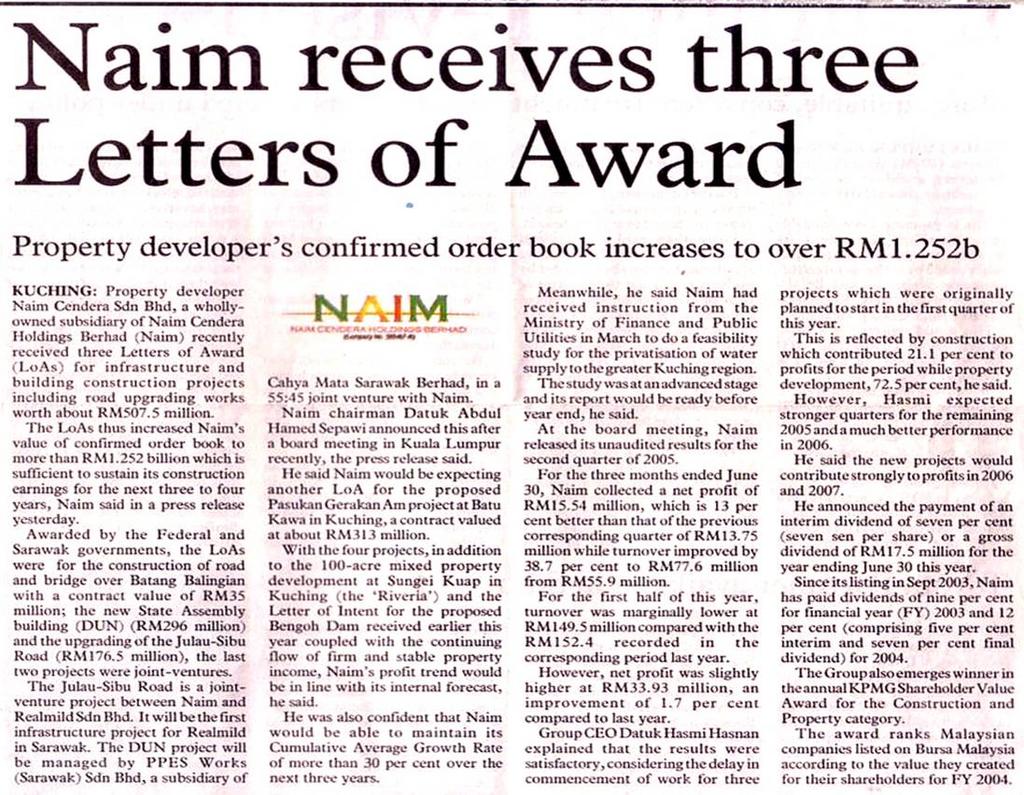
The industry is ushering a new king of construction - Naim Cendera Sdn Bhd, a wholly owned subsidiary of Naim Cendera Holding Bhd (NAIM) - reported that they had been recently awarded three contracts by the Federal and State government of Sarawak for infrastructure and building projects worth RM507.5 million.

The projects awarded include the bridge over Batang Belingian (contract value of RM35 million), the new Sarawak State Assembly building (DUN) worth RM296 million, and the upgrading of the Julau-Sibu Road which is RM176.5 million.

Naim is expecting another award for the Pasukan Gerakan Am project at Batu Kawa in Kuching which is expected to be about RM313 million and has also received a Letter of Intent (LOI) for the proposed Bengoh Dam which is also worth hundreds of millions.
In addition, Naim also is developing a 100-acre mixed development project at Sungei Kuap in Kuching and has other property development projects in Miri, Kuching, etc.

Currently, Naim’s value of confirmed order book is more than RM1.252 billion which may be sufficient to sustain its business earnings for the next three to four years and this book order is expected to be enhanced in the next few months.

Naim’s chairman, Datuk Abdul Hamed Sepawi is confident that the group is capable to maintain a cumulative average growth rate of more than 30% over the next three years.

Naim is poised to be the next kingpin of the construction industry surpassing former greats such as Gamuda, MMC, Roadbuilders, Ho Hup, Suncon, MTD, Mitrajaya, Binapuri and IJM.

Tuesday, August 16, 2005

Robert Kuok Exits Pelangi


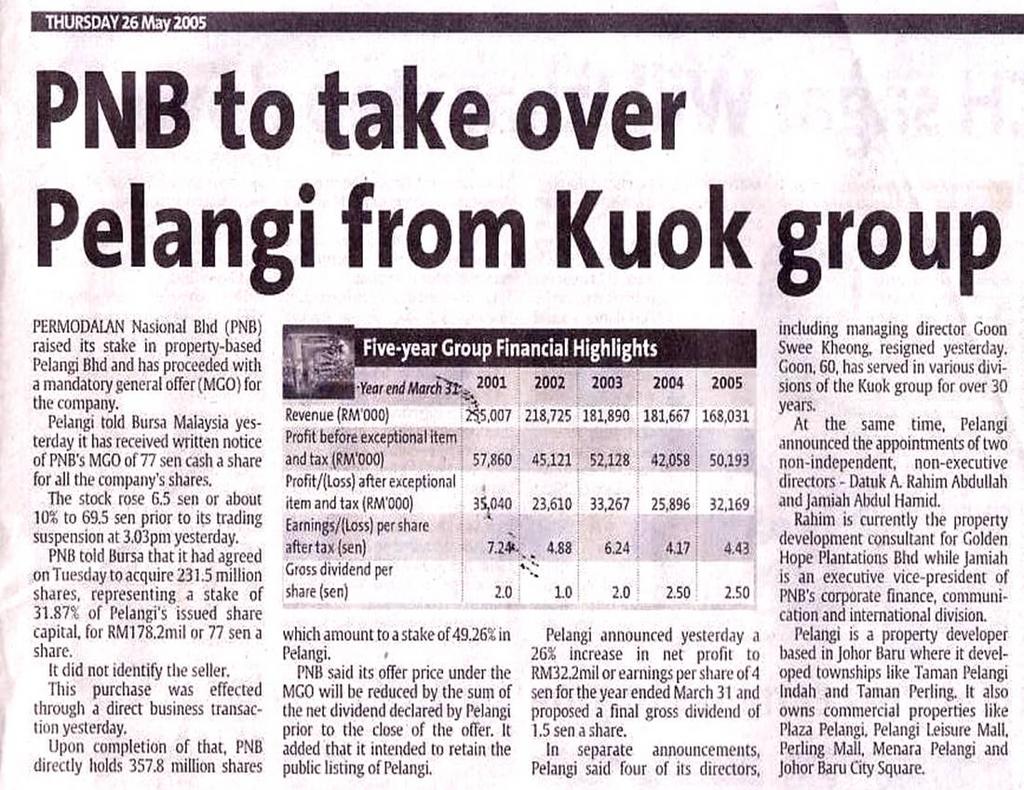
PERMODALAN Nasional Bhd (PNB) expects to complete its acquisition of Pelangi Bhd, a property developer, by next week. PNB president and chief executive officer Tan Sri Hamad Kama Piah said the company had sought a three-week extension for the mandatory general offer (MGO) from July 18.

"We have been given an extension until August 26 for the minority shareholders to accept the offer. We have to wait until then before we can conclude the MGO," he said.

"This was the third extension as some (minority shareholders) wanted time for them to decide (whether to accept the offer)," Hamad Kama Piah told newsmen.

Meanwhile, Bursa Malaysia Bhd said in a statement that it has delisted Pelangi, effective yesterday. Hamad Kama Piah explained that as PNB had acquired more than 90 per cent of Pelangi, Bursa Malaysia had to delist the company according to the listing requirements. Hamad Kama Piah also said an exco has been set up to chart Pelangi's future direction and programmes. "We have decided to let the Pelangi board members determine the direction they want to take and we will monitor their progress. We have appointed exco members to chart and oversee suitable programmes.“ Acquisitions of stakes in companies are very much in PNB's plans, he said, adding that PNB will buy and sell when the opportunity arises. "As a fund manager, we are strategically positioning ourselves in certain areas.“ On the current market sentiment, he said the trend is improving and he believed that the fundamentals are there.

On May 26, 2005, Business Times reported that PNB had made a mandatory takeover offer for the 50.74% stake it does not already own in property developwe Pelangi Bhd for RM 283.74 million. PNB offered to pay in cash for Pelangi’s 369.49 million shares at 77 sen per share. In its financial year ended March 31, 2005, Pelangi reported a net profit of RM32.17 million on the back of RM168 million in revenue.

COMMENTS:

Is PNB Buying into a sunset institution? Pelangi, is a household brand name in housing development, particularly in Johor Bahru, and is reknown for it's quality houses and strategic positionings, and locations. It is generally believed that Pelangi's houses has a 10% premium over market prices.

In fact Pelangi were the one of the pioneer property developer that offers largescale residential housing estates that are 8m wide (24ft width). Those houses, you can see them parking up to four cars within their fenced compound. Most Malaysian residential houses are 22ft or 20ft wide. In Kuala Lumpur and Selangor, you can even see houses of 18ft width. In fact, those buyers will feel claustrophobic.

With the exit of Robert Kuok, Pelangi announced the resignation of Frank Goon Swee Keong as the company’s MD and Datuk Musa Ayub Saad, Datuk Md Zahari Md Zin and Huang Yan Teo as directors.

The success story of Pelangi is synonym with Frank Goon. It was Frank's dream and vision that had brought Pelangi to what it is today, although the credit goes to Robert Kuok. Frank is a brunt and straight man, who is unassuming; he does not accept second best. He is the driver of the system and adopts a power culture. Frank is known to be one who will give stupendous reward to his people who are high performers.

Over the last few years, the property business in Johor Bahru is getting more competitive and less lucrative. Literally, Pelangi had ride on the good market time, a time where competition is not as stiff as of today. Johor Bahru is seeing a mushrooming of housing estates and the infiltration of myraid of "immigrant developers" coming from Kuala Lumpur and Singapore. Profit margins are coming down drastically, tho' still profitable. That seemed to be the objective reason for the readiness of Kuok to exit at a "ripe" time.

PNB will be acquiring an asset in the sunset period. It will pose a great challenge to the acquirer to emulate the previous success story of Frank Goon and his acolyte. Good luck to PNB; and it surely will be better luck to Frank Goon and Kuok Group.

Monday, August 15, 2005

Samy Toll Pre-emptive Strikes


Samy Toll Posted by Picasa

SAMY CALCULATED PREEMPTIVE STRIKE

Samy: Be prepared for rise in toll charges

Works Minister Datuk Seri S. Samy Vellu said the Government had to stop the payout as it could no longer burden itself with increasing costs. “After taking many things into consideration, the Government wants to put a stop to this practice,” he said. As such, he said, the people should be prepared for an increase in toll charges.

Samy Vellu said the Government had to pay out hundreds of millions of ringgit in compensation to the concessionaires when they asked for an increase in toll charges, as provided for in their agreements. “Based on the concessionaire agreements, a toll increase cannot be avoided when the time comes,” he added.

FIRST, he agreed to terms that was North-bound; such one-sided lucrative contracts that would create instant billionaires of which investment bankers would be willing to be bed-partners to fund these projects.

NOW, we are suffocated by the toll-haze; and the directorate is coquetting empathy.

This is the best Ventriloquism you can ever watch!!!! Let dance to the tune .....

Sunday, July 17, 2005

No LRT for Kuching until the Traffic Jam justifies


Sunday Tribune, Sarawak

July 17, 2005.

Sarawak State CVLB Chairman Datuk Wan Junaidi Tuanku Jaafar said it is not a feasible idea to set up a LRT system (Light Rail Transit) for Kuching, Sarawak as it has yet to have high population and massive traffic congestion to justify the introduction of LRT.

So, does it mean that Sarawak will only consider to have LRT after seeing massive traffic congestions?

Why is it that our system of government always choose to be reactive?

Must we face a crisis before any form of planning or actions will be taken to resolve it? When will we learn to plan ahead?

Thursday, June 30, 2005

Another Kelantan Bridge is Falling Down, Falling Down

Bridge of Death Claims another life


For umpteen years, residents of Pengkalan Pasir Village, 6km from Kota Baru, Kelantan had been appealing to the authorities for the repair of this bridge. On February 14, 2005, this bridge claimed its second victim. 5-year-old Noralili Mohd Yusof fell into the canal through a gap between the rotten planks. Last year alone, one villager was killed and two others broke their arms and legs. Perhaps, now the authorities may act.

When Norlili Mohd Yusof drowned after falling through a wooden bridge in February, the authorities swore such an accident would not happen again.

But four months after the five-year-old’s death at Kampung Kok Pasir, a similar accident has claimed another life.

Last Monday, Khatijah Rahmatullah, 65, died after part of a wooden bridge in Kampung Dendang, Ketereh gave way on Monday. The widow’s body was found floating in the canal at 2.30pm yesterday. Khatijah’s son, Mohd Kamal Mohamad, said his mother was returning to a relative’s house after visiting him when the incident occurred at about 8.30pm.

"She comes to my house every night to see my children and then spends the night at a relative’s place," he said.

The incident has once again highlighted the problem of old and rickety wooden bridges over irrigation canals in the State. But an added complication has emerged in the wake of Monday’s incident.

It appears that some bridges were maintained by the State Drainage and Irrigation Department and others by the Kemubu Agricultural Development Authority (Kada).

State Public Works Department director Lim Chow Hock said efforts were being made to repair all bridges maintained by the department. He said while the bridge at Kampung Kok Pasir had been repaired, that at Kampung Dendang came under Kada’s jurisdiction.

When our Prime Minister was addressing the recent civil servants at Kuantan recently, he mention that Malaysia had first class infrastructure and third class mentality. It seem only a half-truth; for we have good infrastructure in the cities but not the kampung; and we have fourth world mentality ........

Sunday, June 26, 2005

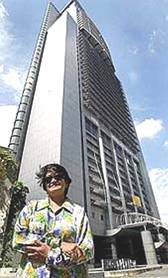
Towering problem for Marina


June 26, 2005, The Star

"EVERYTHING is for sale, including me!" Hajjah Marina Yusoff said half-jokingly when SC Cheah, The Star reporter approached her at the darkened lobby of Menara Marina recently.

Time is running out for Marina Yusoff, the former magistrate, lawyer, politician & an astute entrepreneur (Wanita UMNO leader, and later Semangat 46 leader). She has until the end of this month to pay Danaharta Urus Sdn Bhd the redemption sum of RM122.77 million in cash. Failing to do so, Danaharta may commence action to recover the debt, and she may lose ownership of Menara Marinara, the 36-storey mixed commercial building in Jalan Tun Razak, Kuala Lumpur, which Marina believed to be worth approx RM350.

Over the last 10 years, the project has always been in complex and onerous situation. The project started sometime in 1994, which happen to be almost at the same time the neighbouring project, Wisma Semarak of Telekom started calling for tender for the piling works. If I remembered correctly, Wisma Semarak started the piling works in 1996 and the main building works commenced on 1997, and completed in year 2000.

Both these two projects seemed to faced a lot of difficulties during the construction period - Bad Fungshui or whatever you believe it to be. To add to the difficulties, the economic crisis in 1997-1998 affected the main contractors financial cash flow and disrupted the work progress(both the main contractors are Public-Listed companies - CP Bhd for Marinara and Mancon Bhd for Wisma Semarak).

While Wisma Semarak was finally completed in year 2000, Marinara Tower was still struggling. The project stalled when Pekeliling Triangle Sdn Bhd, the developer and the flagship company of Marina, decided to terminate the main contractor's contract. CP Bhd, the main contractor brought legal actions against Pekeliling Triangle Sdn Bhd.[Period].

Whatever it is, the project did not have a good start, and Marina's hope is that the bad patch will end soon, and that she can recover her investment. Will she? It's going to be extremely tough.

Best of luck, Marina!!!!

Friday, June 17, 2005

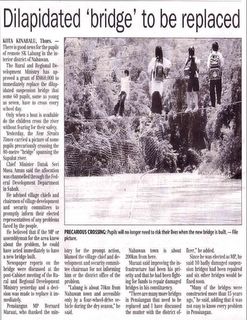
SuperKids crossing Bridge in Nabawan, Sabah


NST, June 15, 2005.

The picture shows the school children who had to daily cling on to their dear life as they negotiate their way across this dilapidated suspension bridges in Nabawan, Sabah.

For many urban children, a trip to school means boarding a car or a bus and being dropped off outside the school gates. But for youngsters at a remote village in Sabah’s interior Nabawan district, the daily trip to school and back is a gamble with their lives. The 60 children of Kampung Labang, some 250km from Kota Kinabalu, have to cross the 80m-wide Sungai Sapulut on a rickety suspension bridge that is nothing more than a few cables strung across the waterway to go to SK Labang. With their shoes inside their school bags, the children aged 7 to 12, walk barefooted on the lower cable with hands grasping the upper cable.

Nabawan district officer Raymond Basir said yesterday that repair work on the bridge would be carried out as soon as possible. But how soon? Before someone gets killed, or what?

$60,000 for Diplapidated Bridge in Sabah

$60,000 allocated to repair the dilapidated bridge


RM51.5 million for landscaping in Kuala Kangsar, Perak and only $60,000 is needed to repair the dilapidated bridge in Nabawan, Sabah. And it took many months, sometimes years to get the approval for such disbursement.

I hope the Sabah State government will not siphon this allocated to pay for a landscape project in Kota Kinabalu Municipality.

In a similar case in February, there, someone had to die to get the authority to start looking at the bridge.


Pengkalan Pasir Village

For umpteen years, residents of Pengkalan Pasir Village, 6km from Kota Baru, Kelantan had been appealing to the authorities for the repair of this bridge. On February 14, 2005, this bridge claimed its second victim. 5-year-old Noralili Mohd Yusof fell into the canal through a gap between the rotten planks. Last year alone, one villager was killed and two others broke their arms and legs. Only after someone had died will the authority begin to act.

I weep for Malaysia! And, how long will it take the bridge to be completed?

Even to Plant Flowers, We Need Consultants?

RM51.5 million for landscaping and RM1.5 million for poverty eradication.

This is what the Kuala Kangsar Municipal Council requested under the Ninth Malaysia Plan.

MP of Kuala Kangsar, Datuk Seri Rafidah Aziz was baffled at the request. "Tourism is tourism, but we have to take care of the people, too," she said, criticising the "topsy-turvy" budget and urging the council to review it.

Rafidah, who is also International Trade and Industry Minister, was puzzled why the council allocated RM11.2 million to landscape its Sayong river front, RM8 million to set up a pocket park, RM3.6 million to upgrade housing areas and RM1.8 million for "greening" the roads.


"Tourists won’t come into housing areas to see the flowers. They have better flowers back home," Rafidah said.

She said that the council should focus on basic amenities, schools, infrastructure and socio-economic activities. Rafidah noted that many budgets appeared skewed towards landscaping projects and intended to raise this matter at the next Cabinet meeting.

During a meeting with Chinese community leaders today, she was told that the National Landscape Department paid RM300,000 in consultancy fees to a company owned by a university lecturer to propose landscaping ideas for Kuala Kangsar.

"Even to plant flowers, we need consultants?"

She noted that the allocations requested for landscaping and beautification projects made up almost half the RM118 million requested by the council under the Ninth Malaysia Plan. She suggested that gotong-royong activities be held to beautify the town, stressing there was no need for landscaping consultants.

The council requested only RM7 million for schools, RM7.6 million for socio-economic purposes, RM13.5 million for city services and RM32 million for infrastructure development.

COMMENTS:

Cheerio Rafidah! You are the first MP to admonish the pedantic dim-wit of municipal council. What about other municipal councils? Previously, there was also a report of the same farcical scenario at Sebarang Perai Municipal but the MP didn't make any sound and the State Local Government Committee Chairman Datuk Dr. Teng Hock Nan backed the council's decision.

The Seberang Perai Municipal Council (MPSP) had then awarded contract worth $1.5 million or about $5,700 a week to contractor to supply and plant flowers at the entrance of the council’s headquarter. Datuk Dr Teng Hock Nan defended the council’s decision saying that the 100 dozen a week of flowers are needed to brighten up the council office.


Hiring a landscape consultant may be necessary for certain circumstances, such as the project at KLCC-Twin Tower in KL, and in housing projects, where there is a need to get professional advice to ensure the landscape projects the values of the community lifestyle and the theme of the park.

But, for Municipality, they can get these advice for free if they call for request for proposal from the various well-established landscaping contractors. Contractors do have their own landscaping experts and are able to submit their proposal based on the need statement of the council.

So, why do we have to pay $300,000 to a lecturer for the consultancy fees? Well, please don't fault the lecturer! He was approach with this opportunity and he make good of that opportunity. The Council should know what they need. According to the lecturer, $300,000 is cheap as it equates to only ONE AP for the import of a luxurious car.

Tuesday, June 14, 2005

DRB Rail Project Land in Arbitration Court


DRB RAIL PROJECT IN DISPUTE COURT Posted by Hello

DRB-HICOM Bhd chairman Tan Sri Dr Saleh Sulong said both the Government and the company have mutually agreed to appoint an independent claim consultant (ICC) to resolve the dispute on the variation order of the double-tracking project between Rawang and Ipoh. The variation order refers to the work ordered by the Government that is not included in the original contract, which reportedly is worth RM700mil.

The ICC or arbitrator will be appointed “which will be acceptable by both parties to address the issue of the variation order,” he told reporters.

For more info on contract & dispute management, go to:
www.projectmanagementysm.blogspot.com

Wednesday, June 08, 2005

Let Us Build The Crooked Bridge


CROOKED BRIDGE Posted by Hello

Johor has made a strong pitch to the Federal Government to go ahead and build the "crooked bridge" to replace the Causeway. State officials said that any further delay in the construction of the project would seriously retard growth in Johor Baru. This message was given to PM Datuk Seri Abdullah Ahmad Badawi during a briefing yesterday.

The Johor government believed that the proposed bridge was an integral part of the re-development of the city centre, and that it was crucial that a decision on the project be made soonest possible.

"Everything hinges on whether the bridge will materialise or not," said a senior state official. "We cannot wait forever for Singapore to join hands to build a straight bridge."

Singapore has not indicated if it is in favour of a straight bridge to replace the whole Causeway, despite two rounds of talks between Abdullah and Senior Minister Goh Chok Tong. This uncertainty is of concern to Johor state officials, who feel the Federal Government should go ahead and build a half-bridge.

MAYBE, A CROOKED BRIDGE IS A GOOD REPRESENTATION OF OUR SYSTEM. That bridge may serve as a mirror for us, to remind us always of our cultured artistic impression!!!!

Sunday, May 01, 2005

Malaysia has record 40,000 Class F Contractor


Record Numbers of Contractors Posted by Hello

COMMENT: In a class by themselves
By Abdul Razak Ahmad, NST, 1st May 2005

Malaysia Boleh sekali lagi!!!!!

According to the Abdul Razak Ahmad, Malaysia has 42,313 registered contractors approximately, one contractor for every 614 persons (based on 26 million population).

This may be yet another world record and should be considered for the Guiness Book of Records.

So, this is yet another Malaysia Boleh-lah...

The only problem is: the Government recently announced a pump-priming of RM2.4 billion projects that will be up for offer, and if each one of this contractor is going to be given part of this cake, each contractor would be having a contract worth RM 56,720. But if the Class A contractors are going to take a major portion, then 35,000 Class F contractor will be jobless and waiting to be wind up.

There are approximately 35,253 Class F registered contractors. They are the smallest fry of the contractor’s world, dependent on government contracts that range from RM5,000 to RM100,000 project.

If we are to add the Class F Ali-Babas, China-Babas, Indian-Babas, Singh-Babas and Mat Salleh-Babas, probably we would have 70,000 Class-F contractors.

The Government, realising it has a problem on its hands, recently announced that it was freezing the issuance of new Class F licences but it is just too late.

The only solution is: follow Mahathir's system of economic expansion and create massive development projects and make more roads, bridges, schools, computer labs, airports, church, mosques, temples, toilets, cyberjaya 2 and 3, putrajaya 2 and 3, twin-tower and queen-tower, etc, etc.. and every contractor will have a job to survive.

If Pak Lah dare not do that, then maybe, Mahathir should come back to rule.

Saturday, April 09, 2005

The Wisdom From CIDB


April 9, 2005, NST Business Times, page 1

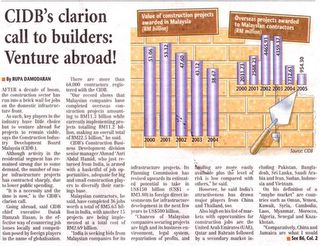
CIDB Call to Builders - Go Abroad Now!

It is a necessity and the time is now - GO ABROAD,” says CIDB CEO Datuk Hamzah Hasan. According to Hamzah, going abroad is the effective way of countering job losses locally and competition posed by foreign players in the name of globalization.

It was reported that CIDB’s Construction Business Development division senior manager Ahmad Asri Abdul Hamid who had just returned from India armed with a basketful of job opportunities, adequate for big and small construction players to diversify their earning base.

Ahmad Asri felt that apart from the need to build capacity, Malaysian contractors must change their mindset and strategise when going abroad. “Overseas is the way … but it is not easy.

The CIDB is at the same time concerned with the quality and ability of Malaysian companies to perform without tarnishing their image abroad. CIDB is currently looking at putting in place a process and mechanism to accredit contractors especially those involved in the overseas market.”

Ask the contractors why they are not going abroad?

The answer is simple. "Kalau tak boleh cari makan di sini, mana ada kemampuan untuk melabur seberang laut?

The first criteria of investment abroad is .....CAPITAL...MONEY... A LOT OF MONEY!!!!! To many of the local contractors, making ends meet is the current problem. Everyone will want to invest overseas, if they had the capacity and SEED CAPITAL. Those who are currently investing abroad, they are either Public Listed Companies (PLCs) or Extremely Rich Businessmen. PLCs can do it as they can seek financial fundings from banks or investment Bankers. Private Limited Companies... you need to come up with million dollars of collateral to get bank to approve any loans. And to tender a foreign project, just to pay for the Tender Bond, put tak Larat-lah!!!!

So, thank you for your kind wisdom, Mr CIDB!

For CIDB's information, almost all contractors knows (including any stupid ones) that going abroad is a right move which will expand the boundaries of business opportunities, but, can you go abroad with your underpants and singlets and tell the foreign client, "PLEASE TRUST ME, I CAN DO A GOOD JOB; I JUST HAVE NO MONEY; JUST GIVE ME A CHANCE PLUS 15% ADVANCE PAYMENT & I WILL PROVE TO YOU SAYA BOLEH DAN MALAYSIA SEMUA BOLEH?"

Why is it that the Koreans and Japanese are successful in investing abroad in the last 30 years? Firstly, it is their Government's policy and effort with strong encouragement and proactive actions from the authorities such as Works Ministry, Construction Development Board, Govt-owned Industrial Banks, etc. Their government had initiated and directed the Industrial Development Banks & Export-Import (EXIM) Banks to fund all contractors who could secure overseas Federal Government-funded projects. Those who could show a letter of award from government-sponsored project overseas, they would be given total fundings. All they do is assigned their payment certificate as collaterals to the EXIM Banks or Industrial Development Banks, and they will receive the cash flows to pay for the project expenses.

Can CIDB do the same for the local contractors, particularly, Bumiputra Contractors and would CIDB KINDLY arrange with the Govt to provide the fundings to Bumiputra Contractors? AND, PLEASE ....Is there any under-table fees?

Tuesday, March 01, 2005

Luxurious ‘EXCO Village’ for Selangor Top Guns

CERMELANG, GEMILANG DAN TEMBERANG


Luxurious ‘exco village’ comes under fire
BY LOONG MENG YEE, THE STAR, PAGE 2, NATION.

The Selangor State Government had spent an estimated MR40 million of public funds to built an “EXCO VILLAGE” in Section 7, Shah Alam comprising bungalows and a clubhouse exclusively for the use of Selangor executive councillors. State Opposition Leader Teng Chang Khim questioned the rationale for the estimated RM40mil project, which comprises 10 bungalows and a clubhouse.

“The state government pays each exco a housing allowance. This payment is more economical than constructing and maintaining the bungalows as the monthly maintenance fee is high,” he said in a press statement yesterday.

As for the clubhouse, he said the excos could become members of the hilltop Kelab Shah Alam by paying RM1,500 monthly.

It is believed that the idea for an “exco village” was mooted last year by the state leadership. The reason was to have a centralised housing area for the councillors, to facilitate easier meeting with each other and the Mentri Besar. They now stay in different locations, some even outside the capital here.

A state official said the bungalows would remain properties of the state. "Most likely, the exco members will lose their monthly housing allowance once they move into the official houses. The state will actually save taxpayers' money because these houses will appreciate in value. We do not have to increase their housing allowances anymore from now,” he said. He said the clubhouse would function as a recreational area and a meeting point; it could even host official events.

It was argued that the bungalows were not extravagant as even district officers and various department heads were given official residences. A survey at the site showed that it is a gated community with a clubhouse right in the centre. Some of the bungalows were fully furnished, complete with bedroom and dining room sets. The gardens had been landscaped as well and workers said the entire “exco village” project had been completed and they were putting the finishing touches.

Is this in compliance with the doctrine of "CERMELANG, GEMILANG, DAN TERBILANG"?

It looks like the government is more towards the doctrine of "TEMBERANG"

Selangor State had decided to increase water tariffs because they could not continue to subsidise the rakyat. But they had no problem to spent multi-millions in building bungalows to appease themselves, plus, paying for trips to watch belly dancers, etc.

Are the rakyat made to look stupid? Did we elect this people to govern us? Oh, my God!!!!!!!

Thursday, February 24, 2005

PLANNED TO FAIL - PAYA INDAH WETLANDS


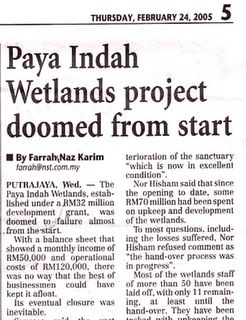
PAYA INDAH WETLAND PROJECT

NST REPORTS - 24TH. FEBRUARY 2004.

The Paya Indah Wetlands established under a RM32 million development grant from the government was doomed to failure almost from the start. With a balance sheet that showed a monthly income of RM50,000 and operational costs of RM120,000, there was no way that the best of businessmen could have kept it afloat. Its eventual closure was inevitable.

So, why did the Government decided to go ahead with the project while the end results is predictable?

Failure to plan can caused failures. Planning to fail; the closure of Paya Indah Wetland in fact confirm that the plan was a success because it was originally planned to fail. Malaysia Boleh!!!!!!

Wednesday, February 16, 2005

Kelantan Bridge is Falling Down, Falling Down ...


Malaysia has 1st. Class Infrastructure?

Hundreds of schoolchildren uses this bridge daily. For umpteen years, residents of Pengkalan Pasir Village, 6km from Kota Baru, Kelantan had been appealing to the authorities for the repair of this bridge. On February 14, 2005, this bridge claimed its second victim. 5-year-old Noralili Mohd Yusof fell into the canal through a gap between the rotten planks. Last year alone, one villager was killed and two others broke their arms and legs.

Perhaps, now the authorities may act.

Didn't we say we have first world infrastructure and third world mentality?
Perhaps, we have both in the third world of darkness.

Friday, December 17, 2004

Water Commission Abandoned


On May 21st 2004, it was reported that "The government had put on hold the privatization of water supply in some states until a regulatory body to monitor water management is set up.

“I urge on-going privatization schemes to hold on to your horses because without benchmarks, the Government will in the end, be left with something unmanageable,” Dr. Lim Keng Yaik told reporters in KL on the 20th May.

Dead serious about improving the quality of water supply and services in the country, the Government is moving to set up by the end of this year a commission to be the sole regulator of the nation’s multi-billion ringgit water sector.

"We hope to do it by the end of this year," Dr Lim told the New Straits Times (March 3, 2004, NST). "I have to implement the National Water Council decision of last year for the Federal Government to take over the management of water from the States." To facilitate the establishment of the proposed National Water Services Commission, new legislation or even constitutional amendments may be necessary," he said. The proposed commission will oversee water supply and related services in all States except Sabah and Sarawak.

On July 27, as reported in StarBiz, Dr. Lim was reported to say that the Government was not asking for the “impossible” when it asked water operators and independent power producers to renegotiate their terms of agreement under the current structure of its privatisation scheme. Water, Energy and Communications Minister Datuk Seri Dr Lim Keng Yaik said the Government was merely asking the players in these two sectors to consider a new holistic structure in the utilities segment to make it more financially viable. “Many banks have come forward to offer their expertise to finance such projects and this shows that utilities projects are bankable,” he told a seminar in Kuala Lumpur yesterday. The Government was expected to invest RM50bil over the next five years to improve water and sewerage services, he said, adding that the amount was a third of the total to be spent under the 9th Malaysia Plan. He said given the huge investment, it was the ministry’s objective to establish a new model for the utilities sector, which would attract private investment and enable the industry to be self-financing and able to deliver to consumers first-rate service at a reasonable tariff.

On August 6, a group of 15 organization and associations, headed by Selangor Malay Chamber of Commerce and SYABAS Chairman, Tan Sri Rozali Ismail submitted a memorandum, addressed to Prime Minister calling on the Government to speed up the privatisation of water supply, if it had decided to do so. It was handed to Domestic Trade and Consumer Affairs Minister Datuk Shafie Apdal during a dialogue with the Selangor Malay Chamber of Commerce here today. Tan Sri Rozali Ismail said frequent water supply disruptions, poor water quality, low water pressure and other forms of water supply problems had consistently affected consumers. Among the points raised in the memorandum was that consumers were now having to purchase individual water filters as a result of poor water quality. Another was that consumers do not want to hear continuously about financial difficulties and the hassles of government bureaucracies before any suggested solution is put forward. An example is the setting up of the National Water Commission. The time that would take for it to be set up has been used as an excuse for not implementing remedial works and integrated actions to solve the problems. Another point raised was that inefficient management and planning of water resources had contributed to the increased level of water lost through leaking pipes, burst pipes and rampant illegal supply connections. These are the factors why water is not a revenue earner. Rozali said if immediate steps were not taken to solve the problems, it would be the consumers who would suffer and subsequently their businesses would be affected in many ways. "Consumers are often informed of the problems causing the lack of water supply but they are not being solved," he said.

On the same day, The Star reported that Dr. Lim had gathered a group of industry players to voice their other concerns pertaining to the water privatization scheme. The water industry players have urged the Government to review some of the contracts awarded by some states, saying they are inconsistent with the current plan to centralise water supply operations in the country. They said some of the contracts were only awarded recently, but not through the Economic Planning Unit (EPU), which oversees privatisation projects. “There could be some irregularities in the way certain contracts were awarded and they should be reviewed in the spirit of creating a level playing field for all water industry players,” an executive with one of the companies told StarBiz. Such concerns were voiced by industry players during a series of meetings organised over the past week by the Ministry of Energy, Water and Communications. “Most players in the state are unhappy about how some of the water contracts were unequal with one company enjoying higher rates than the others,” the executive said, adding that in one instance, payments received by a water company from the state government were based on its total capacity rather than its actual production, as was the case with other water firms. The difference in contract pricing, he said, had resulted in a higher water bill for the state water body, Perbadanan Urus Air Selangor Bhd (PUAS), which had to pay for treated water it did not use. In the long run, such contracts would also disadvantage consumers, the executive said.

On December 9, StarBiz reported that the Government has awarded the privatization of the management of water supply operations in Selangor, Kuala Lumpur and Putrajaya to Puncak Niaga group and Kumpulan Darul Ehsan Bhd.

On December 16, Dr Lim Keng Yaik was reported to say that “Klang Valley’s six million water consumers must be prepared for a 15% tariff hike in a year’s time.

Thus conclude the episode of National Water Services Commission Plan that most likely will not come into fruition, after all the HUHA...

Tan Sri Rozali had won and Dr. Lim can now think of retirement.

For the past many months since the loud proclaimation that the National Water Commission must be set up before the finalization of the water privatization scheme and the firm and unwavering stand of Dr. Lim, I thought, Malaysia now has ONE MINISTER who dares to stand tall and firm and will see his vision through reality. I stood by him, believing that he would not budge, that he is fully convinced that the Water Commission was what we need to resolve the long-term water problem and to set the standards for all other Ministers to Benchmark.

Alas, for whatever reason, either political pressure or self-weakness, the supposedly firm and courageous Minister falls, hard into the garbage bin.

PUAS $1 billion problem is no big deal for the government if they wanted to inject those money into PUAS. The Government can just get EPF to pay by way of issuing Government securities to EPF. So, the excuse that PUAS is in critical and dire straits is paranoid. The truth is, Politcal Maneuvering and Kelptorism.

It concludes that, we actually do not have a man strong enough to stand tall and willing to stretch his neck out, if necessary to be chopped, for the sake of his Vision, Mission and Objectives in the best interest of the Rakyat.

At such, the loser is not keng Yaik, but the Rakyat who will have to pay 15% extra in one year time and thereafter, .....only you can predict the outcome, the price of privatization.

God cannot help those who can't help themselves - the Rakyat!

God certainly help SYABAS ....and it's truely Syabas to Rozali.
Thursday, December 16, 2004

"5 Class F Contractor can becomes 1 Big A" says Samy Vellu


Samy calls 40,000 Class F Contractor to merge into 8,000

Datuk Seri Samy Vellu has suggested that the 40,000-odd Class F contractors merge into about 8,000 companies to bid for major government projects. He said it would be difficult for contracts to be given to individual Class F contractors. “We want to help the Bumiputra contractors but they also need to have vision and merge to get the projects,” Samy said.

I had the opportunity to talk to a few Class F contractors on this matter to see their reaction to the suggestion. The reaction are that:

As Class F contractors, they are short of funds and even if 5 were to merge into 1 as suggested, it would only equal to one bigger poorly financed contractor and they would still be unable to compete with the big boys who had the resources and connections. If 5 of them merge, and try to tender for a big contract, say, Class A or B, (for contracts that are $10 million and above), the performance bond alone would amount to $500,000 for a $10 million contract (5% of contract sum), of which they will not be able to afford. Class F contractors are companies below $10,000 paid up capital and 5 of them will add up to $50,000 paid up (and the paid-up had been fully utilized for setup of office and administration).

It can only be viable merger if the government will waive the performance bond and advance payment bond. That, the Government had to decide if they are absolutely sincere to help the Class F contractors.

Apart from the above issues, the main problems with current Class F contractors is the lack of projects for the 40,000-odd contractors. Big or mega projects are awarded to gaint contractors who would not sublet to Class F contractors due to lack of experience and resources. At such, they had to depend on small projects of which the income from their project will not suffice to cover their expenditure.

If the Government wants the Class F contractors to succeed, there is a need to look into the funding of their operation and providing free training and guidance to them over a period of time so that they will grow in their knowledge and competencies, at the same time, make a little extra money to feed their family, and hopefully, any extra cash leftover, will be used to increase their working capital.

Would the Government be willing to provide the needs of these contractors, or are they going to keep talking and suggesting solutions that are insidious?

Cakap Boleh, Bikin Tak Boleh. 1+1+1+1+1 = 1 Big F